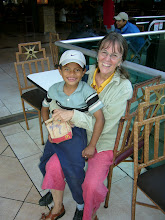
I am delighted to finish a two-year work and publish it on Lulu.com. This novel essentially is my story of volunteering in education and social work near Antigua, then moving to San Pedro to volunteer in education again. But by a stroke of inspiration, I threw in a lovely romance, and the slow uncovering of ancient and modern history in my new village. How that history affects the couple is the crux of this story. Many details of Guatemalan/Mayan customs and traditions, and this enchanting landscape.
Preview it on www.lulu.com/preview/paperback-book/heart-of-the-sky/7239260.
Showing posts with label volunteering. Show all posts
Showing posts with label volunteering. Show all posts
Sunday, June 14, 2009

Saturday, January 19, 2008
Payasos in the Parks


These are some of our payasos (clowns) working with young children in the plaza of their pueblo in San Pedro.
The other photo is of one of our teachers working with children in the plazuela at Santa Ana, close to where I live.
The teachers do Brain Gym activities in the schools. The clowns reach younger children in the parks of their pueblos with preschool concepts (colors, numbers, and the Brain Gym activities of Pedagogia Basica) to help these children succeed when they begin to attend school.
Reports have said that 30% of children fail the first grade because of lack of early stimulation. We'll do what we can. To volunteer with us, see www.idealist.org.
More training
1/19/07
I take a second training in Brain Gym materials here in Antigua on this beautiful January day – a repeat of the one in San Pedro last week. There are about 35 young teachers from the Antigua area here for this training, which is given in a beautifully-designed, well lit and well ventilated building at the Familias de Esperanza project,. The first thing I notice is that most of the participants wear jeans and sports jackets, not typical (traditional) dress as they all did in San Pedro.
The training is scheduled for 8 am. Most of the participants and the trainers are there at 8, but there is a problem; the written materials, which the trainers have to use during the training, are not ready (even though I offered to help and was told they would have all been completed last week.) I am blown away by both the unpreparedness (I think what my boss at Head Start would have done if I started a training without any materials and made the participants wait) and secondly by the patience of the waiting participants. I can just imagine the HS community workers walking out in a huff if I had made them wait half-an-hour. But these folks sit quietly and chat with each other.
The trainers wait, and wait, and finally decide to go ahead and show the video first. And they can’t get the bloody power point laptop to work! They have 3 competent-looking people up in front working on it – sending the girl member of the team out to hunt for other cables, finally producing another laptop. At about 9 am, the trainer decides to go ahead and just start the training – sans video, sans written material – and actually it turns out well; a rather personal warm up for the more scientific material in the video. But I’m still blown away that these quite professional trainers didn’t get someone to check out the materials and equipment BEFORE the training. Or that the young man I thought so much of muffed this so badly.
They teach the various Brain Gym exercises and then get the various participants – mostly young teachers, all of them with little more than a high school education – the only requirement for a primary and secondary teacher in Guatemala, tho many go on to take more classes – to get up and demonstrate how they would teach the children what they had just been taught. I am SO impressed with these young folks! Confidence, a good memory for the details of what has been demonstrated to them, and already some internalization of the philosophy behind the material.
This day really speaks well for the Guatemalan people and the school system! I am really impressed.
I am also a little surprised by two things – probably because of the little that we know in California about Guatemalan culture. One is that some of the activities require the teachers to physically prompt the “children” (adult volunteers) to do the exercises, and that the male teachers seem to think nothing of lifting the women’s arms, or putting their hands on their shoulders or backs to assist them, though noone does more than gesture at the legs (and this is part of the instructions.)
The other is that references are made to the similarities in these exercises, especially the ones involving pressure points and breathing, to tai chi and yoga, and the word “chakra” is used. Although it seems to be assumed that not many have taken classes in these topics, it seems assumed that all have heard of them. And these are teachers from the small pueblos between Antigua and Panajachel, hardly a modern area.
And of course the basic wonder is that the school systems here have embraced the Brain Gym materials for their pre-kinder, kinder, and primary classrooms – taking seriously the need these children (with poor early stimulation) have for left-right hemispheric coordination and requiring these exercises for 20 mins. each morning.
~~~~~~~
I will be going into the local primary schools in the small pueblos around Antigua with the two young women teachers whom I stayed with in the hotel in San Pedro la Laguna. Last week, they, and the woman trainer we had in San Pedro la Laguna, and I spent two days going from pueblo to pueblo, on chicken buses and walking. The local San Pedro, which I'd seen once before, now seemed sprawling and a little dirty; a little edgy. I felt better that I was there with 3 Guatemaltecan women. I remembered thinking on my first trip that I would like to live there, but can’t imagine that on this visit. A nearby school on a coffee finca was the opposite. Up a dirt lane and through a grand gate into the finca, then up two more paths to the tiny two-room schoolhouse. The smiling teacher was very welcoming. The children peeked at us from the doorway. That school should be fun. It seems that the owner of the finca started (subsidizes?) this school, primarily for her workers’ children.
Then I convinced the others that Santa Ana would be easy to reach, so we went there and found the school very close to the house I once wanted to live in when I first looked for a rented home in the Antigua area. In each case, we just located the school and got our bearings, because we have yet to get authorization to enter.
Then we walked down the road I would take for the bus, if I lived at that house, but turned left and took a back road to the next Pueblo - Santa Catarina. The trainer kept emphasizing that we should never walk this road alone. We took a look at the school in that pueblo, and then walked back to the road and took a short chickenbus ride to the project for lunch.
Then into Antigua and walking all over Antigua to see the 6-7 schools there. Throughout this time the three of them are chattering in Spanish. It seems many times that the trainer is repeating the same materials which we already learned in the training, and discussed at the meeting. Maybe these youngsters didn’t catch on as quickly as I thought, though mostly their questions are about how to deliver the materials in the classroom. The answers seem obvious to me, so it is evident that various experiences I’ve had with teaching and going into schools to observe are serving me here.
Cultural differences
There is a knock on my gate at 8:30 am on a Saturday. I’m tempted not to answer – anyone I know would have called, first. But I answer to find an old indigenous man in a plaid sweater and beaten-down hat. He asks for “Christina.” “No soy,” I tell him. He gestures toward a small bookcase nearby, with a carrying strap around it. Ohmigosh, he is one of those bent-over men I see in the street, carrying large or small pieces of furniture on their backs. I ask him, “Have you been carrying this piece?” “Oh si,” he nods, smiling, “de Solola.”
So he has been carrying this piece of furniture (since what hour of the morning?) all the way from Solola…..several hours on the bus and a half-hour walk through town….and his target customer is not to be found. Yet his dark eyes are shining with warmth and his smile carves deep creases in his face. How does he do it? My parting comment to him is not perfunctory: “Que le vaya bien.” (May you go well.)
I take a second training in Brain Gym materials here in Antigua on this beautiful January day – a repeat of the one in San Pedro last week. There are about 35 young teachers from the Antigua area here for this training, which is given in a beautifully-designed, well lit and well ventilated building at the Familias de Esperanza project,. The first thing I notice is that most of the participants wear jeans and sports jackets, not typical (traditional) dress as they all did in San Pedro.
The training is scheduled for 8 am. Most of the participants and the trainers are there at 8, but there is a problem; the written materials, which the trainers have to use during the training, are not ready (even though I offered to help and was told they would have all been completed last week.) I am blown away by both the unpreparedness (I think what my boss at Head Start would have done if I started a training without any materials and made the participants wait) and secondly by the patience of the waiting participants. I can just imagine the HS community workers walking out in a huff if I had made them wait half-an-hour. But these folks sit quietly and chat with each other.
The trainers wait, and wait, and finally decide to go ahead and show the video first. And they can’t get the bloody power point laptop to work! They have 3 competent-looking people up in front working on it – sending the girl member of the team out to hunt for other cables, finally producing another laptop. At about 9 am, the trainer decides to go ahead and just start the training – sans video, sans written material – and actually it turns out well; a rather personal warm up for the more scientific material in the video. But I’m still blown away that these quite professional trainers didn’t get someone to check out the materials and equipment BEFORE the training. Or that the young man I thought so much of muffed this so badly.
They teach the various Brain Gym exercises and then get the various participants – mostly young teachers, all of them with little more than a high school education – the only requirement for a primary and secondary teacher in Guatemala, tho many go on to take more classes – to get up and demonstrate how they would teach the children what they had just been taught. I am SO impressed with these young folks! Confidence, a good memory for the details of what has been demonstrated to them, and already some internalization of the philosophy behind the material.
This day really speaks well for the Guatemalan people and the school system! I am really impressed.
I am also a little surprised by two things – probably because of the little that we know in California about Guatemalan culture. One is that some of the activities require the teachers to physically prompt the “children” (adult volunteers) to do the exercises, and that the male teachers seem to think nothing of lifting the women’s arms, or putting their hands on their shoulders or backs to assist them, though noone does more than gesture at the legs (and this is part of the instructions.)
The other is that references are made to the similarities in these exercises, especially the ones involving pressure points and breathing, to tai chi and yoga, and the word “chakra” is used. Although it seems to be assumed that not many have taken classes in these topics, it seems assumed that all have heard of them. And these are teachers from the small pueblos between Antigua and Panajachel, hardly a modern area.
And of course the basic wonder is that the school systems here have embraced the Brain Gym materials for their pre-kinder, kinder, and primary classrooms – taking seriously the need these children (with poor early stimulation) have for left-right hemispheric coordination and requiring these exercises for 20 mins. each morning.
~~~~~~~
I will be going into the local primary schools in the small pueblos around Antigua with the two young women teachers whom I stayed with in the hotel in San Pedro la Laguna. Last week, they, and the woman trainer we had in San Pedro la Laguna, and I spent two days going from pueblo to pueblo, on chicken buses and walking. The local San Pedro, which I'd seen once before, now seemed sprawling and a little dirty; a little edgy. I felt better that I was there with 3 Guatemaltecan women. I remembered thinking on my first trip that I would like to live there, but can’t imagine that on this visit. A nearby school on a coffee finca was the opposite. Up a dirt lane and through a grand gate into the finca, then up two more paths to the tiny two-room schoolhouse. The smiling teacher was very welcoming. The children peeked at us from the doorway. That school should be fun. It seems that the owner of the finca started (subsidizes?) this school, primarily for her workers’ children.
Then I convinced the others that Santa Ana would be easy to reach, so we went there and found the school very close to the house I once wanted to live in when I first looked for a rented home in the Antigua area. In each case, we just located the school and got our bearings, because we have yet to get authorization to enter.
Then we walked down the road I would take for the bus, if I lived at that house, but turned left and took a back road to the next Pueblo - Santa Catarina. The trainer kept emphasizing that we should never walk this road alone. We took a look at the school in that pueblo, and then walked back to the road and took a short chickenbus ride to the project for lunch.
Then into Antigua and walking all over Antigua to see the 6-7 schools there. Throughout this time the three of them are chattering in Spanish. It seems many times that the trainer is repeating the same materials which we already learned in the training, and discussed at the meeting. Maybe these youngsters didn’t catch on as quickly as I thought, though mostly their questions are about how to deliver the materials in the classroom. The answers seem obvious to me, so it is evident that various experiences I’ve had with teaching and going into schools to observe are serving me here.
Cultural differences
There is a knock on my gate at 8:30 am on a Saturday. I’m tempted not to answer – anyone I know would have called, first. But I answer to find an old indigenous man in a plaid sweater and beaten-down hat. He asks for “Christina.” “No soy,” I tell him. He gestures toward a small bookcase nearby, with a carrying strap around it. Ohmigosh, he is one of those bent-over men I see in the street, carrying large or small pieces of furniture on their backs. I ask him, “Have you been carrying this piece?” “Oh si,” he nods, smiling, “de Solola.”
So he has been carrying this piece of furniture (since what hour of the morning?) all the way from Solola…..several hours on the bus and a half-hour walk through town….and his target customer is not to be found. Yet his dark eyes are shining with warmth and his smile carves deep creases in his face. How does he do it? My parting comment to him is not perfunctory: “Que le vaya bien.” (May you go well.)
To Panajachel again

We are going up to San Pedro, on Lago Atitlan, for a training in the Brain Gym – Pedagogia Basica – materials. The bus finally leaves at 7:15. We pick up two young Guatemalan women in Chimaltenango; along with the young man, Carlos, they will be our teachers. If I decide to volunteer with this project, I will assist them.
One of the girls settles next to me and I try to make conversation, but beyond “Como estas?” I don’t get anywhere. I notice that she is praying. She crosses herself when she is done. Wow, is this act that dangerous?
We ride without talking.
At a construction site on the highway, I watch the roadside vendors. A man stands beside the bus with a table heaped high with homemade sweets. They look very enticing, but I know Guatemalan dulces are REALLY sweet, and I haven’t eaten this morning. When he sees there are no buyers on this bus, he lifts the tray of sweets, folds the legs that were under it, tucks them over his arm and moves on down the road. A woman boards the bus with a basket of warm chile rellenos and tortillas; she moves down the aisle. I am tempted but don’t buy, and few others do. Another woman with an identical basket boards, announces her wares, then leaves. Only a young boy remains by the bus. He has a basket of commercial potato chips and other snacks. He looks about six, but is probably eight or so. He pulls a small wad of cash out of his pocket and counts it, then puts it back.
We finally arrive in Pana after 10 am. These young Guatemalans have never been to Pana before, though they live only 2 hours away. But they walk directly past all the enticing stalls full of market goods and look for the launch which will take us to San Pedro.
The girl I was riding next to, with whom I have exchanged only a few words, suddenly clasps me vigorously and laughingly says she is terrified of the lancha. The other girl says she thinks she will be sick. None of the three has been on a boat before; two of them (like me) cannot swim. They are giggling, but obviously nervous. But suddenly I am the “pro.” I reassure them all, suggesting that they breathe and that the girl relax her stomach and think of the boat as “dancing” (all this in stitled spanish.) I point to the lifevests overhead (which reassures me too) and off we go.
This smaller boat goes around the lake, instead of directly across, and I get to view the dozens of great homes around the lake as well as smaller houses clustered together, many of them rising almost vertically up the mountainsides.
San Pedro is not especially attractive. It is also very hilly. We wait near the dock for the project director. Lots of foreigners walk by; one a young man in dreads with a large tattoo on his arm. My companions don’t seem to notice. The director arrives in the typical indigenous outfit: woven falda and embroidered huipile, which the two young girls are also wearing.. She takes us through this rabbit-warren of streets and alleys, passing the restaurant where she explains we will eat (paid for by the project) and then we arrive at our hotel. The grounds are lovely with lawns, flowers, and big banana trees, but the rooms are minimal, though spacious enough. There is no Tv and not even a reading light. The man and I will each get a single room and the girls room together. 35Q – about $4.50 per night.
The four of us go out for our first afternoon in the town. They are all very accommodating to me; asking me which direction to take at each intersection, where would I like to go next, etc. I’m not sure why this is, but at first don’t think about it, just take charge. The young man is especially gentlemanly to me. They are all in their early 20s.
We look for a Mercado (market), which is prevalent in the two other Lake towns I’ve been in, but the outdoor stalls here hold only CDs, toys and other mostly plastic, commercial items. We finally end up walking out the road where we have been told there is a beach. We can see the lake below us, sometimes with people bathing and washing clothes there; in one or two places, small boats are tied up. I am thinking there might at least be a restaurante out this way, with cokes and a deck looking out over the lake. We walk and walk, AND walk and walk, on the dusty road, but no restaurant. At some point I stop to take photos of a beautiful finca with land stretching down to the lake. This lakefront area would cost a million per acre in Sausalito. No wonder extranjeros have built homes here and there. One of them captures my heart; white stucco with tile roofs, as is the style here, not too big, with a small balcony on the second floor looking out toward the lake, and wonderful vegetable gardens running down to the lake's edge.
I sit down on the unfinished upper floor of a house next to the road, my legs dangling, and look at that house and dream. I could have chickens, and a garden, maybe even a goat, though there don’t seem to be hungry children here as there were in Jamaica. But I’d have to sell my house in California - where my younger daughter is living - and possibly the land is too expensive even then. But "that's MY house!" I say to the three teachers. [And strangely, 2 years later it is!]
Then there are three days (not four as we’d first thought) of trainings each morning in an open air shed off a main street, reached through a tin gate. The trainers are the project director – a 30s-ish attractive, slim, light-skinned woman – and a rather short, lythe, Mayan man in his late 20s with long curls and one day, a Che t-shirt. He was also featured in the video, practicing the exercises with some children; at one point barefoot.
After the first day, I had realized these young people can’t understand my Spanish at all, even when I take time and care. So the first morning, I hunt for a Spanish teacher. I also want the chance to compare another teacher’s style with my teacher’s, which I think has been part of my learning problem. She does SO much of the talking! Two schools are very attractive and fully booked. Each has a lovely room to work in which overlooks the lake. I pass up several which are also laundries or tiendas, and find one which can give me a teacher that afternoon. I ask for three days, but have to cut it to two when we decide to return home on the afternoon of the third day. They are very accommodating and I like the teacher who is assigned to me very much. He tells me, among many other things, that the land that I was looking at is not THAT expensive….maybe 100 thousand quetzales.
The trainings are grueling for me, but I can understand 90% of the man’s Spanish as he speaks clearly. He also watches my face a lot while he’s talking, perhaps because I am the most raptly attentive in the group of 15 or so, perhaps to gauge my comprehension. He seems to be a lovely person, very caring about the kids’ challenges in learning here, due to the constrictions of their early environment as far as development of left/right hemisphere coordination (what this training is about.) Children are often on their mothers’ backs for a good bit of the day (I have seen 4 year olds being carried in a sling while their mother walks some distance.) They don’t crawl much on the bare ground of the campo or the dirt floors of their homes. I have only seen one tricycle since I’ve been here.
The grueling part is the constant attention it takes for me to understand all the Spanish, and my desire to respond to this material with which I have some experience and much interest. I am a little panicked on the first day when we all have to introduce ourselves and say why we are here, but I get through this with some of the words I learned to describe my job in Spanish back in California. A few times I attempt to ask a question or respond in some way, but as I usually meet uncomprehending looks, I stop.
The second morning I talk to the trainer for a few moments during the break, giving him some feedback about his giving mostly corrective responses – no positives – to each young teacher who volunteers to learn during the day, and then ask, “Me comprendes?” He says (in Spanish), “well I do, because I’ve been a teacher of Spanish in the past; I don’t know about the others.” It has never dawned on me that that might be the difference in the response I get from one person to another in Antigua – the level of familiarity with foreigners’ accents and speaking-styles.
The other trainer speaks much more rapidly. As modern as she looks, she draws a complete blank when I speak, but the third morning I talk to her about the similar exercises I used when I taught neurologically-handicapped children 30 years ago. She seems to understand but because I now think she won’t, I am nervous and stumble over and swallow a lot of words, compounding the problem. Ah well.
But I love the exercises, the focus of them, and the accepting philosophy behind this program.
I take the 3-hour training in the morning after breakfast with my companions, where I notice, again, that both the girls pray and cross themselves before eating. We also eat lunch together in this restaurant where noone else ever goes. The food is really minimal in taste, and a little dry, in general, for me; but it only costs $3.50 per meal. (20-25Q.) However, my companions and I are warming up to each other; the girls dare to ask me questions, and I ask about their families and their schooling. These three are high-school graduates, ready to teach children, but one of the girls is taking additional classes at the college in Guate City. Two have already had their own class, as practicantes. I ask about behavior problems. The man (20, but dressed in clean sport-shirt and slacks, with a long key-chain from his belt) says he had them at first, but not later. I can imagine he takes charge in class, as he does with his harem of three women – arranging food for us, conducting our decision-making about food or where to go, except when he defers to me, graciously.
I learn that two of these three responsible young people (19,20 and 23) are eldest children, the other is the eldest at home now, with five younger siblings. I am also an eldest.
They do something else while I am in my Spanish class, trying to figure out why my Spanish is incomprehensible. In the evening after dinner, on the first nite after training, the young man and I talk about music and listen to his. He loves what he calls Trance and I call Dance Hall, though I can’t keep up with the names. It is my favorite, too. We end up dancing on our narrow terrace that runs outside the rooms and overlooks the gardens.
It is a heavenly night. There is a strong wind coming from the lake, but it is just cool, and rather intoxicating as it rustles the big leaves of the banana trees and blows my hair. The stars are out. The girls arrive home and sit on the benches, watching us. We finally get one girl up to learn to dance Cumbia from the guy. We have a pretty good time.
The next nite is too cool to be outside. They elect to visit in my room – the guy brings his boombox in to play music, and I get out the pack of cards I just bought to avoid going to bed early, as I did the night we arrived. The young man spends the rest of the evening entertaining all of us with card tricks, jokes, stories, and various games. I want to suggest Hang Man, and it’s the next one he comes up with. We are all finally on a teasing level with each other, and have a pretty good time together.
The trip back on the third day is delayed when the girls want to go see the woman trainer’s house. Decisions are being made in rapid Spanish around me; I have no idea what’s going on, but just go with the flow. Eventually they are back and we walk up the steep hill to where we’ll meet a camioneta to go back to Antigua. The lake is evidently too choppy for a lancha. Although it does remind me of San Francisco Bay on the Oakland side, it doesn’t look that bad to me. But we reach the top of the hill and a bus is waiting at the corner. After we hop on I remember that camioneta is the local name for chicken-bus, which I have promised myself NEVER to ride back from Pana, since I’ve heard such horror-stories from my Spanish teacher about bus carcases over the side of the roads. The driver gets on. He is dark, young, lanky, and wild-haired. He looks as though his day-job is running drugs, and as though he could be on them at the moment, but he turns out to be a reasonably careful driver, and cautious with his bus. We drive around the lake and go through San Juan, which is really beautiful. I would like to come back here to explore this town.
The driver gets out to open the hood and put water in at the bottom of the climb to Solola. Once again, he stops while we are in the middle of the climb uphill, and his assistant jumps out to add a bucket of water to the steaming engine. I have always been afraid of cliffs, so I keep my attention assiduously to the landward side of the climb. At one point I can’t avoid noticing there are some steep drop-offs to the left, and there – God testing me on this fear, too – when we approach a sharp turn, which requires the bus to move to the outside of the grade, a huge concrete truck meets us coming around the turn. We have to stop right when I wish we could get out of this area - the cliff seems so close and nothing to stop us careening off - and then back up enough to allow the truck to make a turn on the Inside of the hill. We then have to approach the turn, and once again back up toward the edge of the cliff to make the hairpin. It is truly grueling for me, my stomach is in a painful knot, but I just keep breathing and look at the hillside, and eventually we are through it.
I am always enchanted with the job of the bus assistants, who hop off at corners to see if people are headed down the street for the bus, and swing back on while the bus is moving. They also help people with their packages, take money, somehow remember on these packed buses who has paid and who has newly arrived, and generally keep things moving and let the driver pay attention to driving. I like that a lot. But I am amazed, when a woman gets up while the bus is moving and walks toward to front to get out at the next stop that this assistant opens the door of the bus and climbs the ladder to get her parcel from the top, while the bus is going at least 30 mph. She gets off, the bus starts up again, and the assistant emerges from the back of the bus where he’s gotten down the ladder and through the door at the back.
We are often three-to-a-seat on this chickenbus; at one point the dirtiest man I’ve ever seen gets on and sits next to me. He begins a conversation with me in very clear Spanish. Where have I been, where am I going. I talk with him the best I can until he starts asking where my husband is. At this point the young teacher I’m traveling with whispers to me “Don’t talk to him.” I am never rude, but diminish the conversation. Eventually he gets off.
And eventually, three hours later, we arrive in Chimaltenango. The girls get off and go their separate ways, with hugs all around. The young man and I walk for blocks and then hop the bus to Antigua, as my Spanish teacher and I did a few weeks before, arriving at the back of the Mercado (and a bathroom) at about 6:30 p.m.. We part company after we agree I will NOT try to help him prepare materials for the next training in Antigua tomorrow, and instead get ready for my quick trip to California for a family funeral.
I buy a few things at the Bodegona, mochilera still on my back, and then opt for a tuk tuk home. This private if bumpy lift costs me more, to go ten blocks, than a 20 mile trip on the crowded bus.
Home again, Personal musings
Every three months one is required to step outside of Guatemala for a few days, although I’m hearing more and more ways to get around this. However my tickets were bought when I came to Guate in Septemember.
Visiting California after three months in Guate was very interesting.
First, on the bus ride from Sacramento to Chico, I was struck by how grey and barren the fields are, in contrast to Guatemala’s still-green lushness. Then I am surprised by the relaxed warmth of Chico culture, taken for granted when I live here. And Raley’s supermarket! Wow………spaciousness and bright vegetables piled high, and so many choices.
And of course visiting with so many friends, one way or another, and that warmth….so treasured.
After a few days here, I get into winter: the wind, the barrenness, the rain.
And after a very short ten days of family warmth and good friendships, and seeing some old clients, it’s time to leave again.
Extranjeros
On the plane down from Dallas there were at least 20 young Mormon men, on their way to do a two-year Mission in Guatemala. I was surprised to learn that their ONLY mission was to “preach the gospel,” because most church groups come down here to build houses or latrines or do some other specific, needed project. Naturally I was their first victim, though I usually enjoy talking to people about the heart of their faith. These guys were SO earnest, and so excited that I was listening…….it was really pretty sweet, until of course I did NOT want to accept the Book of Mormon. Then the guy I was sitting with asked to pray for me. I resisted, not wanting some sort of scene, but he persisted, I relented and it was pretty simple.
He COULDN’T believe he was finally actually in Guatemala – very excited and quite scared. Reminded me of my first flight.
Finally, I reached what has become my home to find my alleyway festooned with cutout paper streamers. I suspect this is for Navidad, only two weeks away, or perhaps el dia de Guadelupe, not for my homecoming, but it felt welcoming anyway. The house next door has palm fronds tacked to its walls and door. I think this has something to do with the tradition of Mary & Joseph going house to house, looking for shelter….La Posada; the tradition I saw enacted by the Montessori school children in Chico during this trip. I don’t know how the traditional response of the householder goes…. But I’ll learn before then, I’m sure.
Cultural differences
My first morning back, I go to the Bodegona to pick up supplies. On my way back, in the middle of the street is a tiny procession: a shiny pink casket held high by two walking men, the light color in stark contrast to the dark shabby clothing of the people following it….only a few women and children, one man, all looking pretty miserable. I want to respond in some way to the upwelling of feeling I have for them, but don’t know what is acceptable. Feeling a little inept, I stand at the curb for the few moments it takes them to pass.
And the first Saturday that I am back I go to the Mercado on Saturday morning later than usual and encounter a huge crowd (muchadumbre en Espanol) in which I manage to get pickpocketed!
I am distraught, running back and forth between the last stall where I purchased vegetables and the next one where I found I had no money. I had placed my small billfold in an outer pocket of my large market bag, which has a flap, but not enough to deter this determined person. What a drag. I lost my drivers’ license, my credit card, and my ATM card, so not only do I HAVE no money, but I have no way to get any. That was a big mistake; I'll never carry all those things together in one place again.
I go straight home, mad at Guatemala, mad at myself, and slightly shakey. I know the routine, since I lost my wallet some time ago, myself, but this certainly spoiled a beautiful morning and my joy at being back here.
Later I go to a party at BJ’s and look at her gorgeous apartment which she will be leaving, soon, and which I consider for myself briefly, as it is closer to the Mercado and cheaper, but hearing bad things about the landlady and her dog, I decide I can do better. But it is quite lovely except for that, although colder than this house! The entire kitchen and dining room are open-aired.
At this party, I meet Fred, who walks with me to one of the musical events available this evening, AND pays for me because I realize I have no cash. As we walk, he talks to me about volunteering for a Brain Gym-based program here. This is the first time someone has really WANTED me, with my current level of Spanish. Which turns out to be is as good as his, if not better, and he thinks his is fine, and he has been here for more than a year! He just has more confidence than I so he uses his with Guatemaltecos! So I am going to take a training with those folks and see if I have something to contribute.
Volunteering
12/19/06: Today I meet with Fred and Mercedes at Familias de Esperanza and Fred tells me they also need someone to work in the nursery school there. So I will see about that after the training is over (2nd week Jan.) So suddenly, after such a long and frustrating wait, there is some movement! Or at least so it seems. My good friend in Chico, Kathy, is VERY enthusiastic about Brain Gym, and I become so, too, after reading about the exercises and seeing the video.
It’s back to the hospital tomorrow morning. I had the most amazing several moments with Sergio yesterday, after two weeks away. He’s all trussed up so he can’t touch his scab from his cleft palate surgery, (Finally! Why did he have to wait so many months?) and has a tube in his nose, so I can’t lift him, but I leaned over his crib for a long time and got my face closer to his than I usually have done and he just looked at me fully for the longest time. Something very sweet there.
Wednesday and another morning with Sergio, with several of the children who have CP, and with a volunteer from Germany who is as angry as I am – or more – with the nurses who work with the babies. One – actually the cleaning person, not a nurse – is really sweet and loving with them, but most sit around and chat with each other while the babies get nothing but minimum physical care.
There is a tiny one, brand new to the ward, who starts crying for food about 10 am each morning I’ve been there. She’s there for malnutrition, but she has to wait til after 11 for her “pacha” (bottle,) even tho we volunteers start asking when it’s obvious what she wants. And then there’s the practice of feeding the ones who aren’t hungry yet, but that’s a more subtle error.
So out of this came a new fantasy: 1) get some questions answered – what areas do these babies come from? Are there babies whose parents DON’T bring them to the hospital because they’re afraid they won’t see them for the next six months? How do the babies do who ARE returned, five-to-eight months later? Are there some serious or even minor problems down the line due to low stimulation/ non-attachment? Why does it take so long to get their surgeries? 2) If the results seem in line with my hypothesis, I would want to develop a program to help prevent malnutrition in the first place, and for the cleft palate babies, help the babies return home quickly.
1) get money for surgeries quicker
2) nutrition prevention programs
3) followup help, social and nursing, so the babies can return home safely and soon.
I could become very passionate about that.
But as usual, unless I find people interested in the same thing who do speak Spanish better than I, I have to get better at Spanish. I need to talk to that woman I met at Deet’s before much longer. She works at the hospital with the older kids, but is a neonatal specialist, she said.
At least I had one successful spanish interchange w/ a nurse today, where I got her to do something I thought important, though also one unsuccessful one
But now I won’t see them again for a week, because my son Michael is coming to visit for Christmas.
Sergio won’t go home for Xmas. But at least there is one nurse there who spoke to him really sweetly today (besides the cleaning girl) and he responded very strongly to her. So that feels better.
Visiting California after three months in Guate was very interesting.
First, on the bus ride from Sacramento to Chico, I was struck by how grey and barren the fields are, in contrast to Guatemala’s still-green lushness. Then I am surprised by the relaxed warmth of Chico culture, taken for granted when I live here. And Raley’s supermarket! Wow………spaciousness and bright vegetables piled high, and so many choices.
And of course visiting with so many friends, one way or another, and that warmth….so treasured.
After a few days here, I get into winter: the wind, the barrenness, the rain.
And after a very short ten days of family warmth and good friendships, and seeing some old clients, it’s time to leave again.
Extranjeros
On the plane down from Dallas there were at least 20 young Mormon men, on their way to do a two-year Mission in Guatemala. I was surprised to learn that their ONLY mission was to “preach the gospel,” because most church groups come down here to build houses or latrines or do some other specific, needed project. Naturally I was their first victim, though I usually enjoy talking to people about the heart of their faith. These guys were SO earnest, and so excited that I was listening…….it was really pretty sweet, until of course I did NOT want to accept the Book of Mormon. Then the guy I was sitting with asked to pray for me. I resisted, not wanting some sort of scene, but he persisted, I relented and it was pretty simple.
He COULDN’T believe he was finally actually in Guatemala – very excited and quite scared. Reminded me of my first flight.
Finally, I reached what has become my home to find my alleyway festooned with cutout paper streamers. I suspect this is for Navidad, only two weeks away, or perhaps el dia de Guadelupe, not for my homecoming, but it felt welcoming anyway. The house next door has palm fronds tacked to its walls and door. I think this has something to do with the tradition of Mary & Joseph going house to house, looking for shelter….La Posada; the tradition I saw enacted by the Montessori school children in Chico during this trip. I don’t know how the traditional response of the householder goes…. But I’ll learn before then, I’m sure.
Cultural differences
My first morning back, I go to the Bodegona to pick up supplies. On my way back, in the middle of the street is a tiny procession: a shiny pink casket held high by two walking men, the light color in stark contrast to the dark shabby clothing of the people following it….only a few women and children, one man, all looking pretty miserable. I want to respond in some way to the upwelling of feeling I have for them, but don’t know what is acceptable. Feeling a little inept, I stand at the curb for the few moments it takes them to pass.
And the first Saturday that I am back I go to the Mercado on Saturday morning later than usual and encounter a huge crowd (muchadumbre en Espanol) in which I manage to get pickpocketed!
I am distraught, running back and forth between the last stall where I purchased vegetables and the next one where I found I had no money. I had placed my small billfold in an outer pocket of my large market bag, which has a flap, but not enough to deter this determined person. What a drag. I lost my drivers’ license, my credit card, and my ATM card, so not only do I HAVE no money, but I have no way to get any. That was a big mistake; I'll never carry all those things together in one place again.
I go straight home, mad at Guatemala, mad at myself, and slightly shakey. I know the routine, since I lost my wallet some time ago, myself, but this certainly spoiled a beautiful morning and my joy at being back here.
Later I go to a party at BJ’s and look at her gorgeous apartment which she will be leaving, soon, and which I consider for myself briefly, as it is closer to the Mercado and cheaper, but hearing bad things about the landlady and her dog, I decide I can do better. But it is quite lovely except for that, although colder than this house! The entire kitchen and dining room are open-aired.
At this party, I meet Fred, who walks with me to one of the musical events available this evening, AND pays for me because I realize I have no cash. As we walk, he talks to me about volunteering for a Brain Gym-based program here. This is the first time someone has really WANTED me, with my current level of Spanish. Which turns out to be is as good as his, if not better, and he thinks his is fine, and he has been here for more than a year! He just has more confidence than I so he uses his with Guatemaltecos! So I am going to take a training with those folks and see if I have something to contribute.
Volunteering
12/19/06: Today I meet with Fred and Mercedes at Familias de Esperanza and Fred tells me they also need someone to work in the nursery school there. So I will see about that after the training is over (2nd week Jan.) So suddenly, after such a long and frustrating wait, there is some movement! Or at least so it seems. My good friend in Chico, Kathy, is VERY enthusiastic about Brain Gym, and I become so, too, after reading about the exercises and seeing the video.
It’s back to the hospital tomorrow morning. I had the most amazing several moments with Sergio yesterday, after two weeks away. He’s all trussed up so he can’t touch his scab from his cleft palate surgery, (Finally! Why did he have to wait so many months?) and has a tube in his nose, so I can’t lift him, but I leaned over his crib for a long time and got my face closer to his than I usually have done and he just looked at me fully for the longest time. Something very sweet there.
Wednesday and another morning with Sergio, with several of the children who have CP, and with a volunteer from Germany who is as angry as I am – or more – with the nurses who work with the babies. One – actually the cleaning person, not a nurse – is really sweet and loving with them, but most sit around and chat with each other while the babies get nothing but minimum physical care.
There is a tiny one, brand new to the ward, who starts crying for food about 10 am each morning I’ve been there. She’s there for malnutrition, but she has to wait til after 11 for her “pacha” (bottle,) even tho we volunteers start asking when it’s obvious what she wants. And then there’s the practice of feeding the ones who aren’t hungry yet, but that’s a more subtle error.
So out of this came a new fantasy: 1) get some questions answered – what areas do these babies come from? Are there babies whose parents DON’T bring them to the hospital because they’re afraid they won’t see them for the next six months? How do the babies do who ARE returned, five-to-eight months later? Are there some serious or even minor problems down the line due to low stimulation/ non-attachment? Why does it take so long to get their surgeries? 2) If the results seem in line with my hypothesis, I would want to develop a program to help prevent malnutrition in the first place, and for the cleft palate babies, help the babies return home quickly.
1) get money for surgeries quicker
2) nutrition prevention programs
3) followup help, social and nursing, so the babies can return home safely and soon.
I could become very passionate about that.
But as usual, unless I find people interested in the same thing who do speak Spanish better than I, I have to get better at Spanish. I need to talk to that woman I met at Deet’s before much longer. She works at the hospital with the older kids, but is a neonatal specialist, she said.
At least I had one successful spanish interchange w/ a nurse today, where I got her to do something I thought important, though also one unsuccessful one
But now I won’t see them again for a week, because my son Michael is coming to visit for Christmas.
Sergio won’t go home for Xmas. But at least there is one nurse there who spoke to him really sweetly today (besides the cleaning girl) and he responded very strongly to her. So that feels better.
Volunteering, and Cultural Differences
Volunteering with sweet Sergio in the hospital today – despite the cleft in his lip, the most beautiful of the babies - I began to wonder if I am asking him to do more than he should be capable of. If he’s only two months old, not three, yet….well maybe he can’t be expected to grip my fingers and pull himself up. He has no tendency to grip at all, though – I grasp for my memory of my own babies’ capabilities – this seems strange. Yet he pushes like crazy with his feet, against my stomach, the edge of the bed or whatever he can push against…..not enough to keep him upright, but then he’s probably still so young. I decide to go look at the big board where the babies’ statistics are kept. I can’t believe the dates I see, so ask first another volunteer, a young Dutch girl, and then the nurse. Sergio is SEVEN months old. He still just about fits on my lap between my knees and my stomach….that’s about 24 inches…maybe 25, 26. Quickly I look at the other kids’ statistics. I think Alma is the same age….she is eight months old. Two children are doing well – smart and curious and already sitting and crawling – they are 11 months. Two of the much more compromised babies – cleft, but also with cerebral palsy and maybe retardation, whom I thought about 8 months – are already 2 and 2-1/2 years. And the boy I thought was 7 is 12. I am simply stunned. I wonder what I think I am doing, if so much time has passed without the sort of stimulation I am trying to give the babies. Of course, eventually, as I hold and rock and talk to the girl who is most compromised, finally getting a smile out of her (it always feels like a triumph)…..the idea of making progress passes, and I simply hold her and rock her and talk to her, giving her human contact. I am disturbed that with all the children, the nurses simply feed them and put them down. They tend to feed them somewhat upright and facing out…since they all seem to do it the same way, perhaps that’s how they were taught. Maybe it avoids bubbles, because I don’t see any babies being burped, and forget rocking them to sleep. The nurses have a lot of babies to care for, and except for the day some nurses had off, they are always clean, and don’t have diaper rash, so they are doing something. In all my years of working with children, I’ve never worked with those with physical handicaps. So I suppose I am simply adjusting, but my day feels changed as I contemplate the life some of them will live. I feel as though nothing I do will have any effect, and then notice Sergio using his feet against the bars of his crib to turn himself over. He wasn’t doing that two weeks ago. And when I leave for the day, both he and Alma are looking directly out of their crib at me. So maybe, maybe, what I and the other volunteers are doing help push them along toward greater capability, bit by bit. Later in the day, I talk to my teacher about the babies and the things I learned today…practicing my Spanish. She says that malnutrition is rife in Guatemala. The Mayan people are small to begin with, or smaller than Americanos, but poverty and malnutrition produce babies that are tinier than they should be. Still it seems strange to me that Sergio has been in the hospital since April 28….just over six months, and he hasn’t caught up. I still don’t understand it, but suddenly nutrition education – especially when she tells me cleft palates result from folic acid deficiency - becomes for me a more salient need in this country than I had considered.
“It’s the little things,” as my daughter advised. I start off to “work” at 8:45 Monday morning and notice that a van is parked in the middle of the very busy street I live next to, the street the busses use to get out of town. It has a small collection of metal parts under the front bumper. Has it dropped an axle or drive train? A groaning bus full of people comes up the street and manoevres around it. On my way home at noon, I see two men have jacked the van up, and have a box of tools open on the street next to the van. Whatever is wrong they are repairing it right there in the middle of the street. Typical Guatemala.
One day I walk up through Central Park toward the ATM machine which helps me manage my money here, and notice a huge crowd on 5th Calle. I join them and see men and women with numbers on their chests, balancing trays of food. I think perhaps they are going to serve people in the crowd….but how would this be a contest? Best server?? Then they all move down toward the park and line up in a row, and I get a good look at the contestants. They are all dressed differently, evidently the “uniform” for whatever restaurant they work for….even a few women in indigenous dress. This seems a little unfair as some have dress shoes and some tennies, and it seems like this is a race! I notice with amusement all the different “starting” stances they take, from seriously aggressive to casual, and then off they go! This is actually a race….they will go as fast as they can around the park and then down one street and up another, ending where they started…and carrying their trays aloft!! This is hilarious, but they are pretty serious about it. I watch for awhile, unbelieving and delighted, then head for the Bodegona.
There are so many processions here, all taken very seriously. But on All Saint’s Day there is a big one, leaving from Iglesia San Francisco and going up the calle. I stumble on this as I go to my favorite internet cafe. They are carrying the huge "float" (I don't know the word yet for the big box on which rides different sorts of figures, on this day a saint lying down, carried on the shoulders of many people in unison.) At first I think perhaps someone has died, and this is actually his body.....the people seem to be in deep mourning and most in the crowd around the "bier" are wearing black, but then realize it is just a statue. I have heard there is a tradition of Jesus Acostado (lying down); maybe this is what this is? Ahead I see there are a group of men dressed in long purple sort of Arabic headcloths, with the rope to hold it in place. When the "float" reaches them, they trade positions with the bearers and the procession continues. I follow it up the street seeing other groups gathered ahead, in different colors. Wondering, bemused....I go back to the internet.
I went to pick up a package at a nearby receiving station (cargoexpress) where I was told it was safer to send packages than thru the post office, especially because my house has no way to receive any sort of mail (no mailbox or slot.) I told them it had been 13 days since it was mailed from California, so they talked among themselves and decided that perhaps it was at another station. I couldn’t understand the directions the guy was giving me, so he told me to come with him, and walked outside. I thought he was going to point down the street, but he got on his motorcycle (those and scooters more prevalent than cars, here) and motioned for me to get behind. So off we went, whizzing through the cobblestone streets and around the potholes. My first motorcycle ride in a long time, and very fun. And it turned out that the package and a birthday card from my son were at the regular post office - perfectly safe, but undelivered.
I went to my first real concert yesterday (other than free ones in the downtown park.) It was scheduled from noon to midnite. I paid $13 for a ticket and $5 to share a tuktuk with another woman to get there, since it was held in a pueblo outside of Antigua. This woman – a new friend, met at the Macadamia Nut finca trip - is eight or so years younger than me; I was impressed when she told me she drove her car down through Mexico to get here some 18 months ago. When I had contemplated this, I was told it was totally too dangerous and if nothing else I would be required to pay to get through real or bogus “checkpoints” all the way. She said absolutely not; no problem whatsoever, except that her camper was searched at several checkpoints and fumigated at one. Usually she stayed in various campgrounds, of which she said there are plenty in Mexico, but one time she parked on the beach (where I’ve been told you NEVER camp, being more isolated, etc. - and I did meet a woman who was robbed when she camped on the beach in Livingston) and she realized she was stuck in the sand in the morning (shades of Y Tu Mama Tambien.) She hailed a nearby farmer who tried to get her out with his truck but couldn’t; he located another farmer with a tractor and he pulled her out immediately, and wouldn’t accept any money. She has been in Guate ever since, except for going back to the US to sell her car, among other things. She is headed for Peru in a few months. I have met several women traveling alone through C. America, but except for my short jaunts here in Guate, I can't imagine it. I had heard the bands at this concert were from El Salvador and Nicaragua as well as Guatemala, so I was expecting all traditional music, like some I’ve seen so far at the concerts in the park. Well…..no..... The crowd was at least 3/5 Guatemalan, but 90% young; the music was rock, for the most part. I had also expected that there would be a shaded area, with seats, but this was in an open field (demonstrably a cow or horse pasture on other days) with a huge very well-appointed stage (lighting, sound equipment etc.,) comparable to the Grass Valley music festivals in California. The day was sunny and pretty hot, though the breezes came up at 3 pm or so. The bands were mostly young and good enough but not spectacular, with a few notable exceptions. I don’t care for heavy metal but the first band, with a singer with lots of long black hair and a spectacular falsetto, was excellent. The next two were just loud so I went to get some dinner (for $2.50 a crisp bun full of freshly-roasted pork; the entire pigs were there on spits.) Then there was a guitar player from Canada who played solo, who was really exceptional…he also played one tune with Alicia Jo Robins, a fiddle player whose group followed him. She played four or five selections of old-time fiddle, and it was really fun to see some young Guatemalan men dancing to the music, doing the do-si-do and fooling with it, but also just having fun with the bouncy rhythm. Then there was a group of young Guatemalan women musicians in traditional dress, which I looked forward to, but though they were excellent drummers their singing and especially their harmony left a lot to be desired. Then there were two Guatemalan men, Fredy Colorado and his brother, who did Latin TAP dancing and breakdancing! Which of course I loved. And then a band which I would like to locate the name of….possibly Guanamanga….which consisted of an older guy with long grey hair who looked Gringo but spoke impeccable Spanish, and the others all Hispanic….a percussionist who was one of the best I’ve ever heard – on wooden box, and a ceramic pot, as well as more traditional drums – an old man who played various ocarina-type instruments strung around his neck, a woman who sang behind the lead singer, and a bassist. He was definitely good enough to come to the World Music Festivals in Chico. I would have liked to stay for the next two bands, from El Salvador and Honduras, which were also the highlighted bands, but by now the crowd was a little drunk, my legs were giving out from dancing but mostly from standing, and the wind was freezing! I stood by the warm generator for awhile, trying to keep myself going, but eventually gave in and walked out to the road to wait for a tuktuk to get me home at about 10 pm. This act in itself a challenge, as you are warned so often about walking on a dark road alone. In this whole crowd of maybe 800 people I knew one person (my friend – i.e. a woman I’ve met twice - went home early): the guy from my local English-language bookstore, and he was hung up on some young Guatemalan women. I met one person when my friend spoke to her – a woman with long curly grey hair, dressed in a flowing skirt and bright shawl, who told us she is a musician (guitar and flute) and that she was personal friends with a lot of the folks who would be playing. She has lived in San Marcos (on Lake Atitlan) for 13 years. I am still intrigued about gringos who have managed to live here a long time...how they do manage, but there was no time to query her.
Friday, January 18, 2008
Livingston, Guatemala
Then Livingston. I have imagined it many times, having heard that it has only one street, but it is not at all what I expected. Coming in from Rio Dulce, it looks like many towns along the coast of California, say Moss Landing..…moored sailboats and motorboats, some very fancy homes, and many of the unique-to-3rd world country homes of bamboo and thatch on stilts next to the river. Once we disembark, we stop at the first restaurant we come to on the hilly main street, eat a fantastic breakfast with fresh-squeezed oj (I haven’t found any, yet, in Antigua) on the veranda of the restaurant, and watch the people go by. Next to us, two Hispanic women in the large lacy blouses and loose skirts typical of this area work on laptop computers. It turns out that they are associated with the local project for providing job education for young people in this area, which this wonderful restaurant BACAMAMA exists to benefit. I am looking everywhere for evidence of the Garifuna people that Livingston is famous for, but they are in the minority on this cobbled calle, although a few black women approach us with photos of women in a little album, asking us to choose a style to have our hair plaited (just like in Jamaica.) Most people walk or bicycle by, but there are a few cars, which we ask about. Evidently there is a daily ferry, on which any cars have to come. The heat and humidity are really oppressive, but welcome breezes from the river and the Bay are frequent. Maria Cristina and I have hooked up with the young American man and a woman from Holland for breakfast, and we then start off together to explore the town. The first sight is the concrete basketball court, where many people are spending a lazy Saturday watching the local teams play basketball, not futbol as in the Antigua area. We meander along the usual sorts of stalls and small shops, selling local crafts, food, lots of signs for Liquidas – bottled water and sodas. When we get ¾ of the way down the one main calle (although lots of side roads run off into the residential areas,) I ask our tour guide about the Garifunas – is there a special area where they congregate, or something? “Oh they’re all over,” he says, without much interest, but up to this point I have seen very few black people, proportionately. We pass one large attractive restaurant with the word Garifuna in the name, but otherwise I have seen nothing to indicate the presence mentioned in the guidebooks. I had imagined music coming from one after another open-air bar, colorful costume (though what I’d seen on the Garifuna youth playing music at El Pelicano bar in Antigua wasn’t TOO colorful) and the sort of rich patois I’d heard in Jamaica. Then we see a bunch of folks from our tour congregating next to a shack on the side of the street, talking with an old black man with a grizzled beard. He speaks English and as we come up he is describing a tour he and his band had made to Holland, and says that they have recently been in New Mexico. The folks in our group from those areas speak up enthusiastically and he engages with them, naming towns they know, and places they are familiar with. I elaborate about this, here, because he looks like an old drunk and I make the snap judgment that he is b.s.ing us about the grand travels of his band. I take the chance to ask him about the Jovenes de Livingston, the group of young Garifuna musicians I had met in Antigua; hoping, really, to connect with them again, here. He says he has heard about them from many people, but he doesn’t know who they are – they must be from Puerto Barrios, on the other side of the river, and just using the name of Livingston – he seems rather scornful. I ask more about the Garifuna influence in Livingston. He says that they have been more and more shoved out of eminence here by the Hispanics, who had “come in with their restaurants and their culture.” Now the Garifuna are a minority in their “own land.” I ask other questions, and he offers to take us on the tour that the tours don’t offer (he says something about that to our tour guide, who is hanging back from this conversation – in English, which he doesn’t speak – but also with some apparent degree of scorn, or desire to distance.) Five or six of us swing in behind the man – Aurelio Gota – and he takes us (and our reluctant guide) down to the end of the calle, and then along the ocean – because, tho the shoreline along the bay looks the same as along the river, Livingston is where the Rio Dulce meets the bay and then the sea. There is no beach to speak of, and the water is resplendent with some floating plastic bottles and bags, and other wonders made by man. Not dreadful, but not very pretty. We walk along among groups of children playing, a few tiendas offering food or liquidas, people taking their leisure in the cool ocean breeze. Most of these people our impromptu guide speaks to by name, and we of course say Hola and Buenos Dias to everyone we pass. One tienda is playing a CD, and Aurelio says, “That’s my music,” and offers to sell us a CD. I go back to get a cold bottle of water and ask the woman, jestingly, if the music is really his, and she says, “Oh, certainly!” When I return to the group, Aurelio is handing out the CDs and when I take one, I joke with him that I had checked it out and what he is telling us is true. Unfortunately, he takes some offense, even though I apologize and explain to him that so many people try to sell different things to us tourists, and so often exaggerate their value or the story connected with them that we become skeptical. As we continue to walk along the shore – meeting one white couple (from our tour group,) and few Hispanics, but dozens of Garifunas – he shows us a pink and white mansion on the shore, with a beautiful garden, among the shacks that otherwise line the shores. He says that Nazis, fleeing Germany after the war, settled here and remained for 3-4 years, then disappeared. He says that you hardly ever saw them outside their fortress (which had a two-story tower, as if to look out to sea,) but he remembers them. I ask how old he was then and he says about two. I say I was ten when the war was over, born in ’35. He and the young man we are walking with express surprise, and he said he was born in ’53 (which would mean that any Nazis he saw would have had to be there for nearly eight years.) I am shocked because from his appearance I would have thought he was 75 or so. He laughs and says, “Well I was thinking about courting you, but now I know you are old enough to be my mother!”
He then leads us up a steep meandering path away from the ocean, through backyards and into a house, where he introduces his bedridden aunt – probably a bit shocked to have 6-7 foreigners show up while she is in bed. But she is very gracious and Maria Cristina does her usual charming Spanish thing with her, and we leave her with well-wishes for her health. Then through many more back “yards” – this path reminds me very much of the ones we took off the road in Jamaica. A few children bounce along with us for a way, some teenagers call out jokingly to us, many people look askance. I get the feeling that not many tourists show up here. We then go through a big cemetery with gravestones and some larger edifices a bit higgley-piggley on the varied terrain and also, he tells us, tumbled about by the hurricane last year which demonstrated to the people that they needed to abandon their traditional bamboo and thatch houses and begin to build with concrete. This comment interests me, as it suggests that recent hurricanes have been more frequent or more devastating than previous ones.
In the center of the cemetery, he shows us a huge tree 100 feet tall or so (not many trees in Guatemala reach the heights I’m used to in California) and at least 20’ around with many trunks grown together. He says something lovely about the roots reaching down into the graves and the bodies of the people, which include his parents and a sister, feeding this tree spiritually as well as physically.
He has been talking all along about his attempts, as a leader in his community, to keep the Garifuna culture alive, through his music group, but also through his school. The children come there outside of regular school to learn the Garifuna language, history, music, and customs. At this point he shows us the building where his school is located, although he also says sometimes they meet on the beach. He says there hasn’t been much interest by other agencies in helping.
I ask why the community in general doesn’t take part more in the tourist activities, which is the economic base for most of the country……….why not more restaurants, with Garifuna music and dance? I tell him that tourists come all the way here to see the Garifuna culture, and it’s not in evidence – why not take advantage of this? People could raise pigs and goats and chickens and vegetables to supply the restaurants – everyone could benefit! He says, “I think we Garifuna are a lackadaisical people.” An interesting word to use.
What I see is a people being marginalized in their own town…..second-class citizens. But maybe they don’t care. Maybe they are happy with their lives as they are. I know many Europeans and especially Americans have met this sort of lazy resistance to their efforts to improve the lives of various indigenous peoples around the world, who are actually fine with things as they are, or don’t want foreigners interfering.
Given my rather negative experience with child-rearing where I was in Jamaica, I ask him at one point about parent-child relationships: “Are the Garifuna pretty loving to their children?” I say, ingenuously. “Oh sure, they are! Of course they have to be strict with the kids, a little whipping never hurt anybody! These mothers, they are STRONG,” he says, admiringly,” You don’t mess with them.” I hear in his voice his memory of his mother. So, in my mind, it is the same as what I saw in Jamaica….and for that matter in a lot of areas.
When M.Cristina asks about the Garifunas’ relationship to Africa, he goes off on a heated oration for 5-6 minutes about how the Garifuna are NOT, as is said in the books, decendants of shipwrecked African slaves, and not from Africa at all. He knows that the Garifuna people came from Venezuela and spread up the coast (and it’s true that there are Garif settlements all along Central America on the Caribbean…thru Honduras and Belize, for sure.) I don’t know if he actually believes this – he seems to – or if it’s a concept he uses to help the children of his community feel more proud of their derivation.
He then takes us to a locked-up restaurant made of wood but designed to let the air in, as the thatch houses do. In its dark recesses, on a low stage, are four drums of the type I saw with the Jovenes de Livingston group. He says he made the drums and that they are very different from the Djembes of Africa (which is true – much more primitive looking) and he sits down and plays for his very appreciative audience for a few minutes.
He then stands and says the tour is over. He had said all along that we could give whatever we felt for the CDs (home-executed copies) but when we offer 100 Q for the two we had asked for (pretty much all we had-$13) he is offended and says “For the tour, too!” though of course that it was not free was never mentioned. But we cough up what little more we feel we can spare from what we have left for the expenses we will still encounter. And we walk the short way back to the center of town. We still have 50 mins. until we are supposed to meet the boat, so people congregate on the wharf and some have more to eat and another beer, but I am pretty much out of money.
Subscribe to:
Posts (Atom)