The La Posada processions have begun in Antigua. Every nite for (12?) nites groups from the different iglesias around town proceed to selected homes to be welcomed for food and drink. First you hear the sound of small drums and sometimes bells, then here comes the procession, 12 or more people - some with "robes" a la the Middle East (sheets and headbands) who carry the creche, others carry tall lanterns on poles, still others follow, singing. Last nite there were little girls with silver crowns heading the procession. I followed one to the house and watched them open the door, shedding light onto those at the front of the procession, then one by one they entered, still singing. Down the long hallway, through the door, I could see the living room with its tall lighted tree and the family waiting to welcome them. For Antigua's devout Catholics this is the visit of the Holy Family. Anyone is welcomed to come in with the group, but I haven't tried that yet. Maybe when my son comes to visit (today.)
I was especially happy that I had recently attended the La Posada performance put on by the Montessori school children when I was in Chico, to read and hear the song in Spanish, and see the event enacted.
Very sweet, all around.
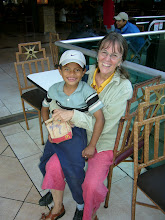
Navidad. This town seems different while my son is here. More inviting, I guess. We try out five different restaurants, partly because of our differing dietary needs, partly just to experience more of Antigua. We also go to my salsa class together, which is a great joy for me. And we go to Sin Ventura, and get to see some of the incredible salsa dancers in this town. This bar is a pretty joyful – and crowded – place this night, where it had been deserted for the nights of Christmas.
And it is just lovely to have my son here. Lots of talk, lots of eating, and walking. A total treat.
And Christmas Eve is incredible. This country’s response to everything is to set off fireworks, but on Christmas Eve they outdo themselves. We sit on my roof-top terrace and every firework ever created is crashing and flashing and booming over our heads. It is spectacular!!! And one also feels connected to all the different smaller pueblos around Antigua, as Santa Maria, San Juan, Jocotenango, and others set off their display. I can see them all from my wonderful rooftop terrace.
In this country so dedicated to its Christian religions, this seems an odd way to greet the birth of their Christ. Yet, maybe just an expression of joy. My son returns to New York for New Years Eve.
A grey January morning in Antigua – 6:30 a.m. I wait for the bus for Pana sitting on a low wall next to the Bodegona. My young male companion from the project stands nearby. My feet are bare in my sandals; I can feel the cold. A man walks by with his hands clasped together, as if praying. Others have their arms wrapped tightly around themselves. A young blond girl waiting for the bus across the street grabs her boyfriend; he clasps her, keeping them both warm. Near me under the stairway leading to the Mochilero’s Place over the Bodegona, a man sleeps on the ground in a blanket. An older indigenous woman stops across the street from me. I watch her adjust her bundle and am struck by the sight of her leathery bare feet on the cold sidewalk.
We get on the bus, which is handled by my Guatemalan companion – where is the bus going, what’s the cost? As I wait, sitting by the window, I notice the camaraderie between two disheveled men when they meet each other….slapping each other’s arms, delighted looks as they walk off together, as if conferring the day’s agenda. A tall man stands where we were sitting moments before. He is eating something steaming from a paper cup. He picks up a scrap of blanket that was lying next to me as I sat there – 1-1/2 feet wide, maybe 4 feet long; synthetic light blue material, slightly dirty. He looks it over, then puts it down again, but before he leaves, he picks it up and tucks it under his arm. How different this street must look to the people who have to live here: Which corner is out of the wind and good to sleep in? What objects can be made use of? Waiting, I attempt a poem: Mami, I watch you stop and settle your bundle in a doorway You reach up and arrange your long hair in a tight knot. Your feet are bare. “No quieres zapatos, Mami?” I would buy them for you if I could; if I knew you wanted them. You place your bundle back on your shoulders, Holding a strap before you in each hand. I know that gesture: a long walk is ahead. “But Mami, the pavement is cold this morning.”
The bus takes off for Panajachel. This is my first time there on a chickenbus (camioneta, locally.)
DAY FIVE - SUNDAY morning I wake about 5:30 but it is still dark. I can’t imagine any ceremonial boat landings are taking place at this hour. When it gets a little lighter I go out, and literally run into a parade of people hooting and hollering and dancing in the streets. I pick up the rhythm as I walk toward them, but then step aside to let them pass. Some rather drunk, rowdy woman grabs me and whirls me into the crowd and off we go dancing down the street, arm in arm. Eventually I disengage from the dizzying energy but another woman grabs me and propels me onward. We are on the way to the cemetery. One woman is carrying a large wreath. Others are carrying bottles of beer. We dance and hop and whirl and drum our ways up into the cemetery, and the drumming stops. People walk quietly. I start to ask a question of a nearby man in Spanish; he says, “You can speak English to me,” and I do, gratefully. He is a Garif, visiting from nearby English-speaking Belize. He says that people will place the wreath on one of the graves. The group passes the huge tree, familiar from my last trip, and convenes at one particular bier. I don’t learn the significance of this one. The woman places the wreath on the grave, the drumming starts again, and a woman “falls out” and starts keening and wailing, her body on the bier. Another woman begins crying loudly outside the circle around the grave. They are both supported by young men, presumably in their family. Other women hug them, several other people are tearful. I don’t know what’s going on, exactly, but I’ve seen this behavior at black churches in Oakland and among my first mother-in-law’s friends. It seems sometimes to be ploys for attention, but sometimes just overwhelming emotion, fully expressed. The trumpet player begins a dirge and I notice how he plays this group of people back into a more contained state of mind. How music hath charms…. Finally, the man I spoke to earlier gestures to me, “I’m going down to watch the landing,” and I follow him. Part way he excuses himself and stops off to talk to some women sitting along the road so I continue alone. I start to go toward the beach near my favorite restaurant, but someone says the landing will be on a different part of the beach. I go there and join five or six other people. We all express doubt about what exactly is supposed to happen and when, but we wait. I decide it’s just a beautiful morning to look at the water and it doesn’t really matter what else happens. We wait. Some people come; some get tired of it and leave. It is quiet and the calm bay stretched out in front of us mirrors the clear sky. I watch some fishermen in a small motorboat throw net out of the boat into the water in a long line. Since they don’t come back and open the circle of net, I can’t imagine how fish are going to get in, or, if this net DID fill, how they would get the weight of it back into the boat. But in 20 mins. or so they come back and throw it all back into the boat. I strain to see fish caught in the net, but cannot. Another mystery. Eventually some people with big stalks of coconut leaves come, and some man in a disheveled costume made of banana leaves, and then some drummers. They begin drumming and some of the assembled older women and then men begin dancing. I love this rhythm, and step off down the street with them, alternating between thinking I am NOT part of this group, thus moving over to the side, then feeling that I love the music and I have a right to step right along with them. I end up taking a place where I can hear the drums well, but am not in the center of the costumed dancers. We join the main street and move into the center of town. I catch a glimpse of the Argentinian taking photos. For some reason I didn’t bring my camera; what a shame. Lots of drumming, lots of dancing; different groups of drummers/dancers moving from one end of the street to the other, passing each other in the middle. Finally there is a candlelight ceremony in the center of the street, words by two of the men I’ve seen over and over in these events this week. A woman is carrying a large photo of what appears to be a gringo man, decked with leaves. I have no idea who he is, but he is treated with some reverence. I finally leave this scene and walk down the street in the direction of my hotel, stopped by a large group of people standing around listening to the music coming out of one funky restaurant. In front of it there are a few big women dancing, probably drunk, but not caring and just having a great time. A wizened old man starts to dance with one of them, pantomiming courtship, playing with it humorously. I love this so much; I’m tempted to join in but keep it to a little wiggling on the sidelines. On the way back to the hotel I see that many people are standing in the doorways to the Catholic Church; apparently the Garifuna mass (misa) is still going on; I was afraid I’d missed it when I attended the non-boat-landing (which I later learn it did take place at 5:30 a.m.) I stand in the side door and watch as a long line of swaying women and a few men approach the altar, carrying fruit, eggs, and even salt & pepper shakers. The drums are beating, everyone is singing the same lines over and over (eventually I can join in.) As the people reach the slightly-swaying Hispanic priest at the altar, he blesses each item and hands it to his assistant. Then he begins the mass, (“hermanos y hermanas”,) which is punctuated at junctures by singing and drumming. The leader of the singing is a young man I met with the Garifuna group in Antigua; he is light-skinned and has cataracts making one eye milky blue. His singing in this context – hands raised in the air - is very beautiful, as is the solemnity yet joyfulness of this ceremony. I remain for an hour or less, swaying and singing, then politely leave when there is a shift in the mass. This “event” is very moving for me; I would like to live where this happens every Sunday. Even though I have many negative thoughts about the Catholic church in Central America, I am always touched by the deep devotion of the people in this country to their religion, especially poor people. I have the feeling that here I might be as close to Africa as I’m going to get (my original dream) but in the jungle rather than the majestic plain. For some reason the dirty streets as well as the hum of activity and the sounds of the Garif language make me think of videos I’ve seen of various small cities in Africa…….and are really appealing to me. After my response to the more conventional beauty of Antigua, this seems a little strange, but I definitely feel it. I amble back to my room and take a nap for an hour or less (because there is supposed to be a big dance to culminate the weekend, tonite, and I could use some rest,) then leave again, and wander through town. I am drawn by music up on the hill where the Garif center is, and follow the straggling crowd up in that direction. There is this huge in-process edifice up there – the future cultural center – an octagonal concrete block structure maybe 30 feet around with huge tree trunks for roof beams, held together with specially-made metal braces. A dream of the future. Under tent awnings, there are 100 or more people dancing….another 200 sit under smaller tent structures, eating and drinking, or standing around on the grass watching the dancers. I join the latter. There is one other white person in the crowd, a woman a little younger than me, her hair neatly braided; we catch each other’s eye with a pleasant look. The dancing is wonderful and amazing. Punta involves intense gyrations of the hips and “fanny,” while making fast small steps in time to the 8th-note-beat and keeping the rest of the body fairly still – except for sudden punctuations of the rhythm with quick movements of the whole body – especially by the men. I LOVE it. There is something so contained and yet intense about it. And the old women in this crowd are the ones who are best at it. (I love that, too!) They are mostly large women, with plenty to shake around, and they do. They pantomime sexy behavior with the old men; they are all laughing uproariously. And they are GOOD. There is also a tiny girl, maybe four; and her grandmother watches her with amazement as she does all the moves, too. A woman of maybe 80, thin and arthritic, does the littlest moves with the whole containment and humorously-mocking facial expressions going……….she also gets some encouraging whoops and hollers. I love this on several different levels. With this and the church event this morning – I can hardly contain myself with happiness. I don’t ever get into full-out dancing, but am shaking myself a bit on the edge of the group.
Then the energy changes, the DJ quits and some Hispanic announcer on a nearby stage encourages everyone to watch a bunch of young girls in sporty/sexy outfits shake their behinds around in more typical MTV-type dancing. They can do it, but it’s interesting to see what a different energy this is. Then they start encouraging people to come up and make fools of themselves for give-away t-shirts. Some of this is playful and fun – the sort of thing I’ve seen twice at festivals around Antigua – but in general I think it sucks; more commercial, more sexy in a dumb way, and nowhere NEAR the dance expertise, even though they are good in an exercise-video sort of way. And of course the announcer just gets off on hearing himself talk. At any rate my interest drops to zer0 and I make my way back down the hill, determined to check back later.
Both my roommates are in the room, ready to take a nap, as am I. Since the second girl has come, Elena has not said two words to me, and seems irritated when I speak to her. Someone else commented on that about her, so I don’t take it personally, tho it is a little odd to be around. Her friend is friendly enough, though I make a mistake with her that I often do with people; criticizing something when I barely know them. She joined a group of drummers here at the hotel with her guitar (first asking permission.) They agreed but she is just a beginner, AND her guitar is out of tune. After a few minutes the drummers excuse themselves and leave her. When she comes in our room, I eschew saying something about her inappropriateness, but suggest perhaps bluntly that the guitar needs tuning. Between us we get it in good order, but still I’ve done it again, as I did to the restaurant owner when – trying to be helpful – I suggest that her hand-lettered sign out front needed work in order to be more attractive to customers (you could barely read it.) When she says defensively that she gets people here all the time, I realize I had done it again. But a day later she suggested that if I were to come here to live she would pay me to do some menus or signs or something on my computer. Still I need to recognize this proclivity to critique BEFORE I do it rather than after.
My last evening. I want a bowl of Tapado and decide to invite my two erstwhile friends, the Argentinian and the Swiss jewelery-maker, to have dinner with me at my friend’s restaurant, thus killing several birds with one stone (what a dreadful analogy!) On the way I run into Prince. He is in his low mood (his girlfriend was here yesterday and dissed him one more time, even handing off some of his clothing to another guy) and looks unsure of his welcome with me, but I am delighted to see him….I’m actually rather fond of him. However this creates a dilemma; I can’t pay for everyone, and I know all these guys are too poor for a 50Q dinner. I decide to walk down with Prince to the restaurant to get him ensconced in her motherly atmosphere. When he’s on a chair on her deck I tell him I’m going to go check w/ a friend and I’ll be back. The two guys I’m looking for are together in the vendor’s favorite spot again and I sit down and tell them I’d like to invite them to have dinner with me at the restaurant. The Argentinian says she once fed him bloody chicken and wouldn’t take it back so he won’t eat there. The Swiss man has another scathing story….they are punching each other’s shoulders and laughing and I realize they are both shit-faced at 4 in the afternoon. I am still joking with them and take two photos of them together. The Argentinian is being charming with every young girl who passes by (and he is handsome and good at it, drunk or no) and accosts an uncomprehending Yugoslav guy about his grandfather from Russia and other somewhat incomprehensible stories but after the guy makes his getaway, he tells us he’s trying to get some investors for his cantina. People don’t realize the opportunity here, etc. I can see an evening with these two is not going to be the nice farewell party I’d imagined, so I tell them how much fun it’s been to get to know them, etc., and head back for the restaurant. Prince has obviously given up on my returning, probably used to that sort of thing from the visitors he attaches himself to, and is down on the beach in the dark, but emerges quickly when he sees me coming. He has a couple of little kids with him, and he takes their leave really sweetly. For all his faults he seems like a heartful man. I ask if he’d like to share a bowl of Tapado with me and he says, “yeah” but hushes to a whisper and says there are better Tapado cooks than this woman. Even he is a little shocked at his faithlessness, and says “with all due respect….” etc, “there are better Tapado cooks.” I expect we will head for some Garifuna place, but he stops at a brightly-lit place run by some Chinese. We order, get some lemonade (he asks if he can have a Pina Colada) and are joined by Elena and her French erstwhile boyfriend. Lots of talk in Spanish, which I follow well enough. I watch the two of them demolish one piece of fish on a plate between them, picking every scrap of meat off the skeleton. The conference couple comes and we talk about not being able to get together here to talk, but she says she will be in Antigua in a few days and perhaps we can meet then. I really like both of them, but I think they look a little askance at the rowdier members of my group. When I turn back to the table, Elena and her friend are gone, replaced by the two women from last nite, Jennie and Kim. The talk flows on. Then they leave and Prince gets into his “can’t sit still” thing. He excuses himself gracefully each time, but runs to talk to someone, runs to get cigarettes, etc. It’s true that the only real connection between us is his sad love-life, and I think he doesn’t want to talk about that tonite, particularly since I’d been right in the advice I had given him earlier in the week. I watch the activity in the street…..families, foreigners, kids in small groups with play guns. Jennie had commented how mean these kids are with each other; very like Jamaica. Eventually Prince returns, and I wonder aloud what has happened to our dinner….they could have caught the fish personally in the time we’ve been waiting. He graciously goes to see where our order is, and returns to say he had to order all over again; the girl had forgotten. He asks for a second Pina Colada and I agree, and get another lemonade although I’m going to be floating before long. I’m a bit worried he will be, too, as I’m hoping to see some night-life with him, but figure the food will help. Then it arrives. I only saw the finished (literally) project before…this soup is more than I can handle. A complete baked fish, head and eyes intact; squid, the same. I love squid but don’t even like to see the tentacles much less the face. At times in my life, I have had my hands inside some still-warm turkeys and a goat, but this is too much for me. I also find, once again, that I don’t like boiled bananas. So I pick at what I can eat and hand over the rest. What I like most is the broth and bread, but this bread is just little round hamburger buns, no garlic toast, like at the other restaurant. I am annoyed that I didn’t follow my own inclinations. But he eats heartily, heads and all…….. though we give the eyes and other bits to a starving dog who is watching us. The dog has such a sweet demeanor that it’s hard for me not to rush out and buy dog food, but I don’t know where I would find it. I briefly think of buying him a hamburger, but then what about tomorrow? He ends up getting quite a bit from our table. I finally get the check: Q112….Or about $14.50. I am a little shocked, food is relatively cheap but drinks are not. There is supposed to be a big “closing” dance at 8 pm, but although the lights of the gimnasio are on and the speakers are blaring, there are only a dozen or so people lining the bleachers and none on the floor. I delight in finding an open floor in Chico, but not here….and I don’t think Prince is ready for that, either. We go off to UBAFU, and the drummers are playing. I tell him one more beer is the end of my budget and we sit and watch the drumming. Somehow I want more than this tonite, so eventually we end up walking over to the gimnasio again. And again just a few people and no dancing. He shows me a tiny disco on a side street…..a bar, really, with a tiny floor and a tiny screen showing a dance competition somewhere. We stand outside for a bit and then I sidle in, lured by the screen and the good music. He evidently can’t come in yet…..when I inquire why he shows me his can of tomato juice. Wow, I love tomato juice…I take a sip, not really noticing his wry look. Good gravy it also contains alcohol of some wretched sort. I spit it in the street. I go on in and dance a bit in the first, nearly empty, room. Then he comes in with me and we go in the inner room where people are gyrating wildly, bumping into each other. I opt for a little floor space, and he tells me he’ll be back in a minute. Some guy wants to dance with me, but insists on getting close. I tell him to back up and give me some space and he doesn’t get it, so I back him up physically. He still doesn’t get the message, so he pulls in a friend to dance with me. We step down and have some fun for awhile. Then Prince is back. I like his movements well enough, and match him, but he is more interested in talking to a friend, banging knuckles and all that greeting stuff. [They have a lovely greeting ritual here – besides the cheek-kissing, which everyone does. The young men do the mutual palm-slide and knuckle banging that I saw in Jamaica but then the fist touches the heart.] We dance for awhile, and then he says he’s going to step outside with his friend. They do and start walking off down the street. I run outside and whistle loudly. He runs back to say, “We’re not leaving you – you can come if you want, or I’ll be right back.” The friend is now pissing in the bushes (a common sight in Guatemala) so I think maybe that’s what they’re up to, so I go back in. Half an hour later he is still not back, and the room has become so crowded and hot that I am out dancing in the cool street. So I decide I have had enough of being “squired” and head off for home through the cool night. They are drumming in UBAFU, but the music from the speakers outside is drowning them out. I go out to see what’s going on, and it’s rap and hip hop. I am delighted, assuming I will see some great dancing, but no. Noone is doing anything interesting. I finally head for home. It is only 11:30 so I decide to pack my bags so I can leave early in the morning. I can still hear the pounding of the speakers in the distance, but suddenly the music stops abruptly and the lights go out everywhere. The available electricity in this small city has been completely overwhelmed. Elena comes in just as I’m getting to sleep. I turn my flashlight on for her and she asks me to wake her in the morning. I thought she was going on to Honduras with her friend the next day, but somehow the friend is staying here another day, Elena is returning to Antigua to meet another friend, and then they are going off somewhere.
Volunteering Thurs. Oct 19. I have certainly been finding it difficult to “get my foot in the door” of volunteering, here. Which seems ridiculous because everyone and their mother, literally, is volunteering. Okay most have more Spanish than I do, but….. I went to the hospital for the tour two weeks ago. Then I thought about it for awhile because those trundled up babies with their smashed-looking faces somehow just didn’t call to me. But I went in last Monday to be told, certainly they would love to have me, but they are full-up for volunteers with the babies for a week. Please come back the following Monday and bring a copy of my passport and two photos, one for the identity card. So I go through getting Milvia to take a photo of me and finding a place to reproduce it, since my printer is refusing to print photos, and on Monday I show up and the social worker isn’t there; she is busy in Guatemala City. I leave my photos. I return on Tuesday and she has only five minutes to talk to me, after talking with another woman and handing her identity card to her, I notice. Yes, yes everything is fine. Yes Monday and Wednesday mornings will work perfectly. So I return Wednesday morning to her office so that she can introduce me to the ward. She isn’t there. The other person, who speaks no English, calls the ward and then tells me, “No, they don’t need any volunteers in that ward.” I am stunned and almost tearful. WHAT? The social worker will return in the afternoon, that day. I leave my Spanish class early and go again at three pm. She’s there, she’s busy with two other potential volunteers. She asks me, in passing, if I started yesterday (that would be Tuesday.) I say, “Un pequeno problema.” When she finishes with the other person, while I wait, wait….she says, “There was some confusion. Yes you are on, but you will have to start next Monday.” She is quite apologetic. I say Monday will be fine. Interestingly this doesn’t seem to be an isolated situation. At least one other person here has told me she thinks volunteers are treated terribly – i.e. ignored, given conflicting information, not really utilized well, etc. And I can say that noone from C.S. has contacted me since receiving my application, though I understand Hanley won’t be back for a few weeks, which makes it make sense. Noone from Families de Esperanza has contacted me despite leaving a note, in Spanish, asking them to; despite signing up to do anything temporarily while I’m learning Spanish (and despite their brochure saying to come work with them because it will help your Spanish.) Very strange. But is this part of American “cultural values,” to think everything should move efficiently? Additionally, so many coordinators of these projects are volunteers, and apparently often with no idea of what possibilities are offered by the expertise of some of their prospective volunteers. Personal A little calculation this morning makes me realize I am living just under my income, including putting aside money for trips home, which won’t always be necessary. Even though I'm paying $600 rent. Cultural There is a schizophrenic Mayan man who lives in the park between my house and the hospital. He is filthy, his curly hair sticks up in all directions; his clothing – the same every day - has become one dull uniform color. I see him in the evening, lying on a park bench, legs sprawled out, a bag with a bottle in it clutched in one hand. Or in the morning, asleep on the ground, if it hasn’t been raining, or on the cement base of a fountain with a little overhang, if it has. In the daytime I see him eating out of the sort of small paper container sold by the nearby food merchants; his face is crumpled and fallen; the look in his eyes dark and inward. I presume he is a drunk too, or maybe drunkenness and schizophrenia have all mingled together in his mind, to produce the mumbling and gestures his disheveled body produces. Nearby school girls in their clean uniforms, relaxing on the grass during a break, laugh at him and point. He seems oblivious. He reminds me of a few schizophrenics I’ve known, obsessively writing down the license plates of all the cars that park on their block (though this man probably cannot write,) or walking into traffic, arm out, shouting at unknown enemies, daring anyone to deny their right to pass. But I wonder what goes on in HIS head; I wonder what the story is that has brought some woman’s sweet clean baby to this pass.
The three volcanos that ring this city are a palpable presence here. Volcan Agua huge, to the South, the visual reference point for orienting yourself when you walk through the city; small Fuega to the West, with its thin puff of smoke, and larger double-crowned Acatenango. Wherever you walk, they are always there, dwarfing the city. People look to them to see what sort of day its going to be…….when Agua is ringed with clouds, or invisible, heavy rain is coming. If you can see Fuego’s thin smoke trail, it’s a clear day. But it’s more than a pragmatic thing; these huge mountains, so close to the city, are like guardians, or sentinels. I can see why the people near Mount Olympus believed their Gods dwelt there. I look to these as if addressing a prayer, and listen for the answer. Agua unleashed a torrent of water in 1541, destroying this City that had been built as Central America’s crowning glory, destroying the many now-ruined churches whose occasional adorned pillars, tumbled walls and half-ceilings still attest to the workmanship and devotion that once graced the city.. So there is respect, too. These are not tame Gods. Some believe that the presence of the lava field that created these volcanoes is part of the energy that created the wars and violence this country has experienced, and the sense of danger that still exists here, despite the relative tranquility of the present city, abundant flowers spilling over its walls.
Nearly the end of October, and the weather continues to be so varied. Cool at night; hot sun in the morning without a cloud anywhere; almost-hail by 3 pm.
LOS NENES [“Nene” is Guatemalan Spanish for “baby.”] I have worked at the hospital three days, with the babies. There was no orientation, just an introduction to the head nurse, who speaks no English. They don’t tell the volunteers what to do, though they may say what NOT to do, based on the doctor’s directions, or, frankly, what makes things easy for them. So we English-speaking volunteers, and there seems to be a new group nearly every week - from Holland, Germany, Canada and the U.S.- teach each other. In this ward, there are about five brand new very small babies who are there for nutrition problems. They are TINY. Occasionally the nurses hand these babies to us volunteers to feed, otherwise they pretty much stay wrapped up in their wrappings, in their heavily padded sit-up chairs in their cribs. If these are preemies, this might be appropriate, otherwise I would like to see them receive more skin touch, more rocking, and be held more closely, looking at their faces when being fed. They tend not to feed them this way, but face them out or at least not close. Then there are two babies, Sergio and Alma, who are about three months old. They both have cleft palates, not too terrible looking. And actually you get used to the gaping hole from the middle of the upper lip up into the nostril pretty quickly. Alma is pretty responsive but it takes Sergio longer. He is really cute though and has begun to look at me more, and is responding to my sounds and words. He pushes with his feet a lot, so I prop him so that he can push against my stomach or the crib if he’s lying in the outdoor one, where we can put three to four babies at once so they can stimulate each other. But we have to watch that they don’t start going for the mouth or eyes. It gets a little hard to juggle all the kids who need attention. Actually it is very hard for me, and I tend to get uptight about it; but I keep reminding myself I can only do what I can do and trying to limit my attention to three to four kids each time I go. There are four older babies, all girls, who have cleft palate, too. One of them has two clefts with two tiny teeth sticking straight out between them. She also has little control over her eyes (or does she “space out?”) and seems to have CP in her legs, and possibly is retarded, too. She was pretty hideous to me at first, but now just looks like herself. It is amazing the way she manages to shift the nipple of the bottle from one side to the other of these two clefts, and essentially chew on the nipple to get the milk to come. All of the babies with the clefts, do this, but it is more obvious with her. Evidently they can’t get suction. One of the nurses tends to feed her by covering her nose with a cloth, perhaps to get suction; this makes her twist and scream. When I fed her there were no problems, so I don’t quite understand it. Two slightly older girls do pretty well; they smile at people, they are ready to play and be picked up. One hollers if she is put down, and most of the other volunteers go for that and pick her up again. I try to interest her in something when she’s put down; she usually settles for that. The other older girl (no more than eight months old) I haven’t gotten to know. She seems to be retarded, too. I will have to be sure to give her some attention on Wednesday. Then, there is an older girl – maybe four years old – in a wheelchair. An older boy of about four is also in a wheelchair, but he also seems autistic. He screams a lot; he hits at the other kids if he’s close, or sometimes at you if you try to play with him, but I think it’s more an attempt to get you to engage than aggression. But he can hit hard. The only connection I’ve made with him is to toss a soft ball or big rag in his lap; he will then sometimes toss it back, but often it goes on the floor, and if I’m holding a baby, it’s hard to retrieve it, so the game stops. He also likes to clap, so I try to get him to imitate the number of times I clap, and I count in Spanish. But I haven’t figured anything more out with him. Then there’s a sweetie of four or five, who likes to put a lot of puzzle pieces in a small box which he can barely hold. He is also in a wheelchair. He is smart, knows some of his colors, can remember your name, and calls “Ayudame” (help me) all the time. He is pretty demanding of attention, but of course he needs and deserves a lot more than he’s getting. However some of the visitors, especially some kids who come with their parents to visit their baby, play with him, and some of the other volunteers. I try to focus on the babies. There is also a boy of about seven, who seems to have CP. He is a sweetheart but is fixated on watches, and asks all day long what time it is and whether he can have my watch for a few minutes. He has one of his own. He is really smart and needs way more intellectual stimulation than he’s getting. I play catch with him when I can, and I’d like to get him a Walkman so he could listen to music or stories. It’s really hard to see all these needy kids, and then sometimes to see the nurses all taking big long breaks together while one or two of us handle all the kids. Maybe no more than ½ hour though. There is one nurse who is really sweet with the kids, nuzzling them when she changes their diapers, for instance. I’d actually like to spend MORE days there, but am trying to keep in at two mornings a week. I don’t want to set up something I can’t sustain. I want to continue with some of the writing I’ve been doing. And want to leave myself open if Camino Seguro finally comes up with something for me to do. All of this is pretty frustrating. When I was here in November there was so much openness to my volunteering, so much sense that volunteers were really wanted and needed, and now……??? Is it just the Spanish? Or is a lot of it a sham? Or is there something about me? I would say at Familias de Esperanza I made the mistake of suggesting that things in one group for parents should be run a little differently, (just a little!) and I think that didn’t sit well. But……there is NOTHING there for me to do, in any department? I don’t know, but I have to be more careful with my behavior in the future. Being critical or suggesting you know better is not the way to start. But of course the first day at the hospital I got huffy and finally went to the doctor when it took them ½ hour or more to come up with a diaper I could put on a very wet, and eventually partially naked baby (while all the nurses took a very long break, sitting in the middle of the room, drinking coffee and chatting.) So that is the babies’ department. I enjoy it; I would like to help more, but again there is the sense of frustration that it is a drop in the bucket, and that the nurses need some training in bonding and attachment and early cerebral stimulation, that I could probably give, or someone should be giving. But we’ll see. I’ll try another approach (being quiet, just doing my job, and perhaps modeling for parents or staff, but I won’t worry about that part.)
Then Livingston. I have imagined it many times, having heard that it has only one street, but it is not at all what I expected. Coming in from Rio Dulce, it looks like many towns along the coast of California, say Moss Landing..…moored sailboats and motorboats, some very fancy homes, and many of the unique-to-3rd world country homes of bamboo and thatch on stilts next to the river. Once we disembark, we stop at the first restaurant we come to on the hilly main street, eat a fantastic breakfast with fresh-squeezed oj (I haven’t found any, yet, in Antigua) on the veranda of the restaurant, and watch the people go by. Next to us, two Hispanic women in the large lacy blouses and loose skirts typical of this area work on laptop computers. It turns out that they are associated with the local project for providing job education for young people in this area, which this wonderful restaurant BACAMAMA exists to benefit. I am looking everywhere for evidence of the Garifuna people that Livingston is famous for, but they are in the minority on this cobbled calle, although a few black women approach us with photos of women in a little album, asking us to choose a style to have our hair plaited (just like in Jamaica.) Most people walk or bicycle by, but there are a few cars, which we ask about. Evidently there is a daily ferry, on which any cars have to come. The heat and humidity are really oppressive, but welcome breezes from the river and the Bay are frequent. Maria Cristina and I have hooked up with the young American man and a woman from Holland for breakfast, and we then start off together to explore the town. The first sight is the concrete basketball court, where many people are spending a lazy Saturday watching the local teams play basketball, not futbol as in the Antigua area. We meander along the usual sorts of stalls and small shops, selling local crafts, food, lots of signs for Liquidas – bottled water and sodas. When we get ¾ of the way down the one main calle (although lots of side roads run off into the residential areas,) I ask our tour guide about the Garifunas – is there a special area where they congregate, or something? “Oh they’re all over,” he says, without much interest, but up to this point I have seen very few black people, proportionately. We pass one large attractive restaurant with the word Garifuna in the name, but otherwise I have seen nothing to indicate the presence mentioned in the guidebooks. I had imagined music coming from one after another open-air bar, colorful costume (though what I’d seen on the Garifuna youth playing music at El Pelicano bar in Antigua wasn’t TOO colorful) and the sort of rich patois I’d heard in Jamaica. Then we see a bunch of folks from our tour congregating next to a shack on the side of the street, talking with an old black man with a grizzled beard. He speaks English and as we come up he is describing a tour he and his band had made to Holland, and says that they have recently been in New Mexico. The folks in our group from those areas speak up enthusiastically and he engages with them, naming towns they know, and places they are familiar with. I elaborate about this, here, because he looks like an old drunk and I make the snap judgment that he is b.s.ing us about the grand travels of his band. I take the chance to ask him about the Jovenes de Livingston, the group of young Garifuna musicians I had met in Antigua; hoping, really, to connect with them again, here. He says he has heard about them from many people, but he doesn’t know who they are – they must be from Puerto Barrios, on the other side of the river, and just using the name of Livingston – he seems rather scornful. I ask more about the Garifuna influence in Livingston. He says that they have been more and more shoved out of eminence here by the Hispanics, who had “come in with their restaurants and their culture.” Now the Garifuna are a minority in their “own land.” I ask other questions, and he offers to take us on the tour that the tours don’t offer (he says something about that to our tour guide, who is hanging back from this conversation – in English, which he doesn’t speak – but also with some apparent degree of scorn, or desire to distance.) Five or six of us swing in behind the man – Aurelio Gota – and he takes us (and our reluctant guide) down to the end of the calle, and then along the ocean – because, tho the shoreline along the bay looks the same as along the river, Livingston is where the Rio Dulce meets the bay and then the sea. There is no beach to speak of, and the water is resplendent with some floating plastic bottles and bags, and other wonders made by man. Not dreadful, but not very pretty. We walk along among groups of children playing, a few tiendas offering food or liquidas, people taking their leisure in the cool ocean breeze. Most of these people our impromptu guide speaks to by name, and we of course say Hola and Buenos Dias to everyone we pass. One tienda is playing a CD, and Aurelio says, “That’s my music,” and offers to sell us a CD. I go back to get a cold bottle of water and ask the woman, jestingly, if the music is really his, and she says, “Oh, certainly!” When I return to the group, Aurelio is handing out the CDs and when I take one, I joke with him that I had checked it out and what he is telling us is true. Unfortunately, he takes some offense, even though I apologize and explain to him that so many people try to sell different things to us tourists, and so often exaggerate their value or the story connected with them that we become skeptical. As we continue to walk along the shore – meeting one white couple (from our tour group,) and few Hispanics, but dozens of Garifunas – he shows us a pink and white mansion on the shore, with a beautiful garden, among the shacks that otherwise line the shores. He says that Nazis, fleeing Germany after the war, settled here and remained for 3-4 years, then disappeared. He says that you hardly ever saw them outside their fortress (which had a two-story tower, as if to look out to sea,) but he remembers them. I ask how old he was then and he says about two. I say I was ten when the war was over, born in ’35. He and the young man we are walking with express surprise, and he said he was born in ’53 (which would mean that any Nazis he saw would have had to be there for nearly eight years.) I am shocked because from his appearance I would have thought he was 75 or so. He laughs and says, “Well I was thinking about courting you, but now I know you are old enough to be my mother!”
He then leads us up a steep meandering path away from the ocean, through backyards and into a house, where he introduces his bedridden aunt – probably a bit shocked to have 6-7 foreigners show up while she is in bed. But she is very gracious and Maria Cristina does her usual charming Spanish thing with her, and we leave her with well-wishes for her health. Then through many more back “yards” – this path reminds me very much of the ones we took off the road in Jamaica. A few children bounce along with us for a way, some teenagers call out jokingly to us, many people look askance. I get the feeling that not many tourists show up here. We then go through a big cemetery with gravestones and some larger edifices a bit higgley-piggley on the varied terrain and also, he tells us, tumbled about by the hurricane last year which demonstrated to the people that they needed to abandon their traditional bamboo and thatch houses and begin to build with concrete. This comment interests me, as it suggests that recent hurricanes have been more frequent or more devastating than previous ones.
In the center of the cemetery, he shows us a huge tree 100 feet tall or so (not many trees in Guatemala reach the heights I’m used to in California) and at least 20’ around with many trunks grown together. He says something lovely about the roots reaching down into the graves and the bodies of the people, which include his parents and a sister, feeding this tree spiritually as well as physically.
He has been talking all along about his attempts, as a leader in his community, to keep the Garifuna culture alive, through his music group, but also through his school. The children come there outside of regular school to learn the Garifuna language, history, music, and customs. At this point he shows us the building where his school is located, although he also says sometimes they meet on the beach. He says there hasn’t been much interest by other agencies in helping.
I ask why the community in general doesn’t take part more in the tourist activities, which is the economic base for most of the country……….why not more restaurants, with Garifuna music and dance? I tell him that tourists come all the way here to see the Garifuna culture, and it’s not in evidence – why not take advantage of this? People could raise pigs and goats and chickens and vegetables to supply the restaurants – everyone could benefit! He says, “I think we Garifuna are a lackadaisical people.” An interesting word to use.
What I see is a people being marginalized in their own town…..second-class citizens. But maybe they don’t care. Maybe they are happy with their lives as they are. I know many Europeans and especially Americans have met this sort of lazy resistance to their efforts to improve the lives of various indigenous peoples around the world, who are actually fine with things as they are, or don’t want foreigners interfering.
Given my rather negative experience with child-rearing where I was in Jamaica, I ask him at one point about parent-child relationships: “Are the Garifuna pretty loving to their children?” I say, ingenuously. “Oh sure, they are! Of course they have to be strict with the kids, a little whipping never hurt anybody! These mothers, they are STRONG,” he says, admiringly,” You don’t mess with them.” I hear in his voice his memory of his mother. So, in my mind, it is the same as what I saw in Jamaica….and for that matter in a lot of areas.
When M.Cristina asks about the Garifunas’ relationship to Africa, he goes off on a heated oration for 5-6 minutes about how the Garifuna are NOT, as is said in the books, decendants of shipwrecked African slaves, and not from Africa at all. He knows that the Garifuna people came from Venezuela and spread up the coast (and it’s true that there are Garif settlements all along Central America on the Caribbean…thru Honduras and Belize, for sure.) I don’t know if he actually believes this – he seems to – or if it’s a concept he uses to help the children of his community feel more proud of their derivation.
He then takes us to a locked-up restaurant made of wood but designed to let the air in, as the thatch houses do. In its dark recesses, on a low stage, are four drums of the type I saw with the Jovenes de Livingston group. He says he made the drums and that they are very different from the Djembes of Africa (which is true – much more primitive looking) and he sits down and plays for his very appreciative audience for a few minutes.
He then stands and says the tour is over. He had said all along that we could give whatever we felt for the CDs (home-executed copies) but when we offer 100 Q for the two we had asked for (pretty much all we had-$13) he is offended and says “For the tour, too!” though of course that it was not free was never mentioned. But we cough up what little more we feel we can spare from what we have left for the expenses we will still encounter. And we walk the short way back to the center of town. We still have 50 mins. until we are supposed to meet the boat, so people congregate on the wharf and some have more to eat and another beer, but I am pretty much out of money.