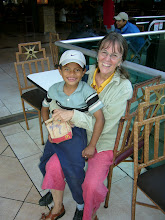
I had difficult loading up enough photos to do honor to Semana Santa in San Pedro la Laguna, but if you'll go to my facebook page -- I think it's under Mira Talbott-Pope -- you'll find a photo album for Semana Santa 2010 that has 25 or so photos with descriptions that give some sense of the history and culture.
I love living in San Pedro. You get used to wherever you live, but when I think about this place, looking at it from the outside, it's so deep and rich. I feel blessed.
Saturday, April 03, 2010

Thursday, April 01, 2010
SEMANA SANTA 2010-04-01


El dia de la procesión de los niños., today…dia del virgen. This procession through the alfrombras, or beautiful fruit-and-flower carpets, in the streets ¨to the cross¨ affected me more than recent others have, maybe because the procession of children in special dress or costume-- some of the boys carrying the andas of Christ; some of the girls carrying Mary-- stopped on a large straw mat at various corners of the main calles of San Pedro (where usually I go to the ATM machine, buy my cards for my celfone, or buy my fruit and vegetables.) There tables had been set up with candles, flowers, and incense, and several old ladies in traditional dress, under a huge double arch of fruits and vegetables.In each of these spots or “stations of the cross,” a different child read a passage from the bible describing this station (Christ fell here and a soldier helped him up, it was difficult here and a follower wiped his brow, etc.) and all the people recited the appropriate group response. Really beautiful to hear the solemn voices. And then the whole column proceeded slowly to the next station, the or carriers with a side-to-side swaying motion, and the old ladies in the rear singing out of books that looked as old as they did.The children were adorable, as always,but the thing that always gets me is Mary following her son to his cruxificion. It was after all, a true story, whatever Mel Gibson made of it. I could become a Catholic, for all the chanting and incense, and the personal story of Christ; I just happen to have bad feelings about the Catholic Church.Que lastima.
Wednesday, March 31, 2010
Big Doings in the Neighborhood
This morning - of Miercoles Santo (Holy Wed.) - there was suddenly a commotion in the street above my house: the large things they whirl over their heads that make a grating sound, dirge-like sounds from the trumpets and saxophones and the thump of the big two-headed drum: a procession! I left my weeding to go out in the street in the t-shirt I wore to bed plus decent pants...(no bra, hair uncombed)...just to see what was up and ended up sitting there for two hours..
A family just down the street who carry two of the oldest names here - Quiacain and Chavajay - were evidently hosting this event, and had a plastic tarp spread over their small garden.
The procession arrived very slowly--while I and my new pup and several neighbors sat on the sidelines to watch--the noise-makers, the band and drum, and probably 40-50 men in straw ten-gallon hats (a few wearing traditional embroidered pantalones) accompanying an older woman in a bridal-like veil, who carried a swinging incense-burner, and behind them probably 50 women with their traditional checkered shawls and behind them a motley crew of hangers-on, children, more men.
They all went inside the garden and sat. Various men and a few women made some sort of speech or prayer, in Tz'utujil, and the large audience rumbled their replies....a sound reminiscent of the ocean.
Eventually the family started dishing out "atol" (a corn drink, served in an embellished coconut shell) to the people in the garden, and then emerged with these round-bottomed vessels to serve people in the calle, even us. The drink is fairly thick, salt-less, sugar-less, with spices of anise (which grows all around here) and a slight picante bite. Many people came to get the drinks. They must have served at least 150 people.
Evidently the man of this family is currently in charge of the "Cofradia de Santa Cruz," one of the many cofradias or Catholic brotherhoods in the pueblo. So he pays for much of this, but all members of the cofradia also help with money outlay, setup of the scene, and cookingof the atol.
More praying and eventually they came out with the canastas of fruit and veggies that I had heard would end the hour-long event....but wow!....30 women bearing plastic baskets on their heads full of mostly plantains but other fruits as well , then 50 men bearing the same (tho because of the cowboy hats and because they're men, they carry them on the right shoulder)....and then 30-40 more men each carrying a large pod produced by a plant that I think grows on the coast....it looks rather like two primative canoes glued together, face to face....with long prows...about 6' long. I have seen them before in Antigua, and have always been fascinated with the pod - it is used in many ways in the alfombras (ceremonial carpets constructed in the streets for the processions of Semana Santa, including the cross-carrying Jesus to pass through)....the cascara itself cut and used as a "vase" for flowers, the long creme-colored branches inside used whole, or just the tips with their little creme-colored seeds or these seeds separated from the branches and piled together in shapes and designs along with all the other forms of fruits and vegetables to create these amazing carpets. (see photo attached to older post on Semana Santa.)
I don't know where these pods were headed---tomorrow night is when they make these beautiful alfombras all night long. I am hoping to find someone I know making one so I can take part for the first time. But I know the many canastas of fruit were headed to decorate the stanchions they erect over the way of the procession.
As these activities gather together toward Friday - Viernes de la cruxificion - (for instance my painter friend and his group have for weeks been painting the first "anda" or "float"--except that it is carried by hand, or shoulder.) that will be in the procession, one can't help but get caught up in the wonder of it (much as I hate some things that the Catholic Church represents.)
It's truly beautiful and there is testimonial to wonder and faith.
A family just down the street who carry two of the oldest names here - Quiacain and Chavajay - were evidently hosting this event, and had a plastic tarp spread over their small garden.
The procession arrived very slowly--while I and my new pup and several neighbors sat on the sidelines to watch--the noise-makers, the band and drum, and probably 40-50 men in straw ten-gallon hats (a few wearing traditional embroidered pantalones) accompanying an older woman in a bridal-like veil, who carried a swinging incense-burner, and behind them probably 50 women with their traditional checkered shawls and behind them a motley crew of hangers-on, children, more men.
They all went inside the garden and sat. Various men and a few women made some sort of speech or prayer, in Tz'utujil, and the large audience rumbled their replies....a sound reminiscent of the ocean.
Eventually the family started dishing out "atol" (a corn drink, served in an embellished coconut shell) to the people in the garden, and then emerged with these round-bottomed vessels to serve people in the calle, even us. The drink is fairly thick, salt-less, sugar-less, with spices of anise (which grows all around here) and a slight picante bite. Many people came to get the drinks. They must have served at least 150 people.
Evidently the man of this family is currently in charge of the "Cofradia de Santa Cruz," one of the many cofradias or Catholic brotherhoods in the pueblo. So he pays for much of this, but all members of the cofradia also help with money outlay, setup of the scene, and cookingof the atol.
More praying and eventually they came out with the canastas of fruit and veggies that I had heard would end the hour-long event....but wow!....30 women bearing plastic baskets on their heads full of mostly plantains but other fruits as well , then 50 men bearing the same (tho because of the cowboy hats and because they're men, they carry them on the right shoulder)....and then 30-40 more men each carrying a large pod produced by a plant that I think grows on the coast....it looks rather like two primative canoes glued together, face to face....with long prows...about 6' long. I have seen them before in Antigua, and have always been fascinated with the pod - it is used in many ways in the alfombras (ceremonial carpets constructed in the streets for the processions of Semana Santa, including the cross-carrying Jesus to pass through)....the cascara itself cut and used as a "vase" for flowers, the long creme-colored branches inside used whole, or just the tips with their little creme-colored seeds or these seeds separated from the branches and piled together in shapes and designs along with all the other forms of fruits and vegetables to create these amazing carpets. (see photo attached to older post on Semana Santa.)
I don't know where these pods were headed---tomorrow night is when they make these beautiful alfombras all night long. I am hoping to find someone I know making one so I can take part for the first time. But I know the many canastas of fruit were headed to decorate the stanchions they erect over the way of the procession.
As these activities gather together toward Friday - Viernes de la cruxificion - (for instance my painter friend and his group have for weeks been painting the first "anda" or "float"--except that it is carried by hand, or shoulder.) that will be in the procession, one can't help but get caught up in the wonder of it (much as I hate some things that the Catholic Church represents.)
It's truly beautiful and there is testimonial to wonder and faith.
Tuesday, March 30, 2010
What's different about living in Guatemala?
Of course it depends on where you live...if you're in the Capital, I imagine that you have most amenities but one constant concern would be security. Maybe someone living there could set me straight on that...I know there are many beautiful sectors of that huge city. In Antigua, you have all the European/US/S. American influences...in music, art, food...but it is a small city, so this is still somewhat minimal. Primarily there you have the sense of antiquity, since it is the oldest large city in Central America...originally capital to the area from above Chiapas, Mexico, to Costa Rica. It is a truly beautiful town, and you can live there comfortably, though I found it cheaper to live just outside Antigua, itself.
At Lago Atitlan, the differences between towns is more marked. San Pedro la Laguna has - to me - a lovely combination of rural and indigenous influences, and some amenities from the US/Europe. This is important to me primarily due to my food allergies - I need some foods that are NOT corn tortillas, beans and cheese. I also love to have the use of the internet, and now have it in my house for about $26 per month, instead of going to a local internet "cafe" (which could be a room in someone's house.)
But what is different about living here? Randomly: public toilets are amazing - you never know what to expect. You can pay 1-2Q and get a small bundle of toilet paper as you enter, wade thru the 1/2 inch layer of water on the floor and find a bowl without a seat, and a bucket to put water in the toilet afterward. That's the fancy toilets. The others, you never know...but an abundance of water OUTSIDE the toilet and none inside is pretty common (think: hold up your skirt, your packages and your purse while you try to manage everything else.)
A common re-use of a plastic coke or water bottle, even by the public utility system, is to cover wires to keep them out of the rain. Many people also use this in place of something to expand or extend the light, so you'll find the light bulb - usually the coiled energy-efficient fluorescent type (who knew?) - encased in a plastic bottle with the bottom cut off.
Plastic bottles are also used to direct water from the rain gutter into a smaller tube to direct the water away from a walkway or whatever. Lots of inventive uses for things of this type.
Houses and even stores are kept quite dark for energy (money) saving.
Showers: forget hot water. Unless you have an on-demand heater - in the fancier homes - or a gas heater, in some hotels - get used to a tepid shower. Or so I thought: very recently I figured out if I take my showers at 10 am, when the sun has been on my black plastic Rotoplas tank for a few hours, the additional heat provided by the tiny electric showerhead (don't touch it while wet!) is sufficient for an almost-hot shower. A great pleasure.
If a truck or car breaks down in the street, expect it to stay there, no matter how much traffic passes, until the owner or someone he hires gets his tools out, crawls under the vehicle and gets it going again. I don't think there are tow-trucks! And noone seems to mind, or complain. Everything her is taken with a "grain of salt." -- "No importa." "No tenga pena." "No hay problema." "No te preoccupas." Common phrases (it's not important, don't worry about it, no problem.)
Money: first you get used to the exchange rate with Quetzales/dollars - it was 7.55/1 when I first came to Guatemala; 3 years later it's more like 8.05. So my money goes a little further!
But there's more to it than that: 100 quetzales is about 13 dollars ....but for 100 quetzales you can buy two nice meals in a nice restaurant, or a pair of good quality used shoes for 75q, 50 q pays my cable bill for my tv (ok only about 30 canals and mostly in Spanish, but...I get Animal Planet and Discovery as well as CNN.) By the way, I found out that the So You Think You Can Dance series I watched so avidly was 6 years old. Wanna watch your favorite old series?
My rent for a really nice 2 bedroom house with a nice smallish garden is $185 per month....but there was no real kitchen, just a 4-burner "camping" stove on a plastic table and a tiny refrigerator....no shelves or cupboards til I put them in (two beautiful wooden cupboards "to order" cost me about $100.) There is no water in the "kitchen" but the bathroom is out the door and down the terrace and around a corner....15' away. And the bathroom itself is a trip - it's outside the main part of the house (as is true of most houses built by local folks) - and is so small, the sink is the size of a large dinner plate, the toilet is just past it, and behind that is the shower. The whole thing about 4' x 8'. I had to put up a curtain to keep from showering the toilet. And of course there's a hole in the roof enough to wet my head as I sit on the toilet when it rains. But the house itself is pretty gorgeous, and my terrace is a lovely place to sit in the evening, with a small view of the lake, a slight breeze, and all the sounds of the frogs and crickets.
From my terrace I can see men working in the corn and peanut fields just outside my garden fence...some in bare feet and traditional clothing. I rent a piece of land about 30 x 40 for $12.50 per month for my veggie garden. Hard going; hard to figure out what grows well here. There are banana trees growing down the road in several places, but the only things that do well in my garden are the "Spring" veggies and fruits in California. Go figure.
Transport is easy here. A tuktuk (3 wheeled motorcycle-with-cab from India) will take you where you want to go, with just about anything you want to carry, including lumber, plastic chairs for someone's party, whatever.) A pickup truck has a regular route thru this town and off 10 miles or so to San Pablo, where "my" classroom is. You stand up in the back with all the other folks for a couple of quetzales.
If I want to go to one of the other towns around the lake, a public boat is the only answer (unless I want to hire a private one.) 20Q to go to Pana (Panajachel.) This morning, 15Q to Santiago to buy some things to take to California to sell....to bring money back here for my projects.
These reflections on differences are just for starters, but I have to GO to Santiago early this morning because the afternoon is filled with activity: our food giveaway for the parents of the kids in our drawing classes, rush home by tuktuk because water only comes to my house and gardens 3 times a week (4 hours total) and today that's at 3 pm, then rush back up town to attend a weekly board meeting for another project I help.
The painters' project (a website I'm in the process of creating) is at www.paintmyfuture.org,
Ta'a Pi't Kortees is at www.taapit.org. Check them out!
At Lago Atitlan, the differences between towns is more marked. San Pedro la Laguna has - to me - a lovely combination of rural and indigenous influences, and some amenities from the US/Europe. This is important to me primarily due to my food allergies - I need some foods that are NOT corn tortillas, beans and cheese. I also love to have the use of the internet, and now have it in my house for about $26 per month, instead of going to a local internet "cafe" (which could be a room in someone's house.)
But what is different about living here? Randomly: public toilets are amazing - you never know what to expect. You can pay 1-2Q and get a small bundle of toilet paper as you enter, wade thru the 1/2 inch layer of water on the floor and find a bowl without a seat, and a bucket to put water in the toilet afterward. That's the fancy toilets. The others, you never know...but an abundance of water OUTSIDE the toilet and none inside is pretty common (think: hold up your skirt, your packages and your purse while you try to manage everything else.)
A common re-use of a plastic coke or water bottle, even by the public utility system, is to cover wires to keep them out of the rain. Many people also use this in place of something to expand or extend the light, so you'll find the light bulb - usually the coiled energy-efficient fluorescent type (who knew?) - encased in a plastic bottle with the bottom cut off.
Plastic bottles are also used to direct water from the rain gutter into a smaller tube to direct the water away from a walkway or whatever. Lots of inventive uses for things of this type.
Houses and even stores are kept quite dark for energy (money) saving.
Showers: forget hot water. Unless you have an on-demand heater - in the fancier homes - or a gas heater, in some hotels - get used to a tepid shower. Or so I thought: very recently I figured out if I take my showers at 10 am, when the sun has been on my black plastic Rotoplas tank for a few hours, the additional heat provided by the tiny electric showerhead (don't touch it while wet!) is sufficient for an almost-hot shower. A great pleasure.
If a truck or car breaks down in the street, expect it to stay there, no matter how much traffic passes, until the owner or someone he hires gets his tools out, crawls under the vehicle and gets it going again. I don't think there are tow-trucks! And noone seems to mind, or complain. Everything her is taken with a "grain of salt." -- "No importa." "No tenga pena." "No hay problema." "No te preoccupas." Common phrases (it's not important, don't worry about it, no problem.)
Money: first you get used to the exchange rate with Quetzales/dollars - it was 7.55/1 when I first came to Guatemala; 3 years later it's more like 8.05. So my money goes a little further!
But there's more to it than that: 100 quetzales is about 13 dollars ....but for 100 quetzales you can buy two nice meals in a nice restaurant, or a pair of good quality used shoes for 75q, 50 q pays my cable bill for my tv (ok only about 30 canals and mostly in Spanish, but...I get Animal Planet and Discovery as well as CNN.) By the way, I found out that the So You Think You Can Dance series I watched so avidly was 6 years old. Wanna watch your favorite old series?
My rent for a really nice 2 bedroom house with a nice smallish garden is $185 per month....but there was no real kitchen, just a 4-burner "camping" stove on a plastic table and a tiny refrigerator....no shelves or cupboards til I put them in (two beautiful wooden cupboards "to order" cost me about $100.) There is no water in the "kitchen" but the bathroom is out the door and down the terrace and around a corner....15' away. And the bathroom itself is a trip - it's outside the main part of the house (as is true of most houses built by local folks) - and is so small, the sink is the size of a large dinner plate, the toilet is just past it, and behind that is the shower. The whole thing about 4' x 8'. I had to put up a curtain to keep from showering the toilet. And of course there's a hole in the roof enough to wet my head as I sit on the toilet when it rains. But the house itself is pretty gorgeous, and my terrace is a lovely place to sit in the evening, with a small view of the lake, a slight breeze, and all the sounds of the frogs and crickets.
From my terrace I can see men working in the corn and peanut fields just outside my garden fence...some in bare feet and traditional clothing. I rent a piece of land about 30 x 40 for $12.50 per month for my veggie garden. Hard going; hard to figure out what grows well here. There are banana trees growing down the road in several places, but the only things that do well in my garden are the "Spring" veggies and fruits in California. Go figure.
Transport is easy here. A tuktuk (3 wheeled motorcycle-with-cab from India) will take you where you want to go, with just about anything you want to carry, including lumber, plastic chairs for someone's party, whatever.) A pickup truck has a regular route thru this town and off 10 miles or so to San Pablo, where "my" classroom is. You stand up in the back with all the other folks for a couple of quetzales.
If I want to go to one of the other towns around the lake, a public boat is the only answer (unless I want to hire a private one.) 20Q to go to Pana (Panajachel.) This morning, 15Q to Santiago to buy some things to take to California to sell....to bring money back here for my projects.
These reflections on differences are just for starters, but I have to GO to Santiago early this morning because the afternoon is filled with activity: our food giveaway for the parents of the kids in our drawing classes, rush home by tuktuk because water only comes to my house and gardens 3 times a week (4 hours total) and today that's at 3 pm, then rush back up town to attend a weekly board meeting for another project I help.
The painters' project (a website I'm in the process of creating) is at www.paintmyfuture.org,
Ta'a Pi't Kortees is at www.taapit.org. Check them out!
Tuesday, July 07, 2009


San Pedro la Laguna is finishing it's last day of feria--a two week period of carnival rides, video game and food booths, and constant activities, parades, etc. The men in the photo at the right dance all day and evening for six days straight! (The photo to the left is similar costumes in a parade in Antigua from 2 years ago.) It seems impossible; I asked a local friend if different people wear the same costume at different times of the day, and he said no, it's the same person. I asked "How can that be?" and he said, "It's like a sport." But of course it's also a time-honored custom in Guatemala--a depiction of the conquistadores, from several centuries ago.
There are three sets of masks, usually lots of young white faces (they also wear white stockings) depicting regular soldiers, two or more who look like the officals or high-ranking "officers," and then the bulls, who often play a comedic role. One of the bulls, this time, looked to be about 5 years old, but my camera batteries quit before I could get a shot of him.
Other parades were of the princesses of each school, and then the princess of San Pedro.
Sunday, June 28, 2009
Crisis in Honduras
A military coup d'etat (or golpe de estado) took place this morning in Honduras. Evidently the background is a referendum called for by the president, Manuel Zelaya, in order to change the constitution. He asked for the military to protect the people as they went to vote. This somehow resulted in his asking the leader of the military to step down, and other military leaders did so voluntarily. Leading to the coup.
Excellent background article.
http://globalvoicesonline.org/2009/06/27/honduras-crisis-over-controversial-referendum/
Quoted in this article are several bloggers from Honduras, and latin-americans writing from the U.S. which show the opposing views on the call for referendum. Worth reading.
Excellent background article.
http://globalvoicesonline.org/2009/06/27/honduras-crisis-over-controversial-referendum/
Quoted in this article are several bloggers from Honduras, and latin-americans writing from the U.S. which show the opposing views on the call for referendum. Worth reading.
Saturday, June 27, 2009
El dia de feria en San Pedro la Laguna


Wild, wild days. Rain all afternoon yesterday, the streets running with small rivers, people picking their way around them to get to the booths that line every street--full of roasted meat or corn, muchissimas hard bagel-looking things, video games galore, shooting galleries, plastic toys for kids, sports shoes, etc etc. We went to see the Queen of San Pedro crowned, when it was reputed that queens from all the other pueblos would come dressed in the tipica clothing indigenous to their pueblo. But of course it was raining, so feet and the hem of my long skirt soaked, I headed for home....only to learn this morning that of course the rain stopped just in time for the event, which I missed.
This morning I headed out to see the procession of "queens of sport" (reina de deportes) from each school in town. Really adorable marching bands in full uniform (a month's wages for some daddies,) and a decorated floats for each of the queens. All the girls were in traje (traditional clothing) and each float had it's own theme---one young girl throwing candy at the crowd from the middle of a huge paper flower, another with Respect the Environment blazoned on the front of the truck, another with "Let's avoid using plastic." I loved both of those. In the left photo, above, is a little sports queen next to two boys in tipical male clothing, playing a marimba. The back part of her float had been ingeniously set up to depict something you often see at fairs, but the announcer was saying not here in San Pedro-- a tall pole which rotates to swing men--or in the case boys--dressed up a monkeys (serves sort of the Coyote function in Guatemalan tradition) at the end of long poles. In the photo on the right you can see the boys in red fluffy suits, hanging---but they are actually having fun. The man sitting at the top of the pole is rotating the pole. Click on the photos to see the details.
Sunday, June 14, 2009
POLITICAL LANDSCAPE
A local, indigenous friend of mine drew a parallel between current Guatemalan politics and what is and has been going on in Boliva, Brazil, Venezuela--the new liberal trend. As a long-time liberal, I am of course delighted that the needs of the poor are being listened to, that education and health care are being funded, etc. But as a person slightly more jaded than I, he says, sure....they see that a more stable political base is the huge number of poor rather than the much fewer ricos! A redefinition of power. And according to him, each of these persons is using the poor as a stepping stone to personal power. Lasting personal power.; in each of these cases, the president is taking steps to ensure his own succession.
I can see the logic in this. This same person says that the current accusations against the president are just the rich trying to stop him. Maybe this is true too (it's a little hard not to believe the written and video evidence.) I think a little light is leaking into my ivory tower.
I can see the logic in this. This same person says that the current accusations against the president are just the rich trying to stop him. Maybe this is true too (it's a little hard not to believe the written and video evidence.) I think a little light is leaking into my ivory tower.
Published!
I am delighted to finish a two-year work and publish it on Lulu.com. This novel essentially is my story of volunteering in education and social work near Antigua, then moving to San Pedro to volunteer in education again. But by a stroke of inspiration, I threw in a lovely romance, and the slow uncovering of ancient and modern history in my new village. How that history affects the couple is the crux of this story. Many details of Guatemalan/Mayan customs and traditions, and this enchanting landscape.
Preview it on www.lulu.com/preview/paperback-book/heart-of-the-sky/7239260.
Preview it on www.lulu.com/preview/paperback-book/heart-of-the-sky/7239260.
Tuesday, May 19, 2009
Guatemalan Debacle
Early this week Guatemalans were stunned to learn of accusations against their current president, Alvaro Colom, his wife and an aide by a lawyer who made a video saying he expected to be assassinated and that they would be responsible for his death, as well as that of another lawyer and his adult daughter who had been murdered the week before. The second lawyer was found dead, shot while bicycling two or three days after making the video, and a friend made sure the video reached CNN and other news venues.
The story behind this staggering story is that Colom, et al, were accused of using public money to launch private ventures through Banrural, the biggest bank in Guate. The first lawyer refused to have anything to do with this but gave documents proving the ventures to the second lawyer. Both were subsequently killed to prevent the information getting out, so the accusations go, but it emerged anyway, thanks to rather brave friends.
This is of course huge.
It is sad for me, because I had many hopes for Colom's presidency--the first liberal in many years. It is sad for many because some good things have been happening in education and health during his tenure. It is also terrible because this poor country can not get going without one thing or another providing a huge disruption. And now of course this president has to attend to his defense rather than the huge efforts that this country needs.
And should there be a coup by the army or the civil sector, it would be a devastating upheaval.
There are many calling for him to step down, but he of course refuses and denies all charges. Wisely he has asked for the UN and the FBI to come in to investigate the charges.
Many were afraid of a coup, which has happened so many times in the past.
I felt it would be a test of Guatemala's maturity at this point -- could they pursue and resolve these accusations and a change of government (there is a named vice-president) if needed, without upheaval??
So far, that is happening. The investigation is supposedly underway. There have been huge protests in the capital, but orderly protest (and shows of support -- held in two different plazas.)
Keep your fingers crossed for us.
The story behind this staggering story is that Colom, et al, were accused of using public money to launch private ventures through Banrural, the biggest bank in Guate. The first lawyer refused to have anything to do with this but gave documents proving the ventures to the second lawyer. Both were subsequently killed to prevent the information getting out, so the accusations go, but it emerged anyway, thanks to rather brave friends.
This is of course huge.
It is sad for me, because I had many hopes for Colom's presidency--the first liberal in many years. It is sad for many because some good things have been happening in education and health during his tenure. It is also terrible because this poor country can not get going without one thing or another providing a huge disruption. And now of course this president has to attend to his defense rather than the huge efforts that this country needs.
And should there be a coup by the army or the civil sector, it would be a devastating upheaval.
There are many calling for him to step down, but he of course refuses and denies all charges. Wisely he has asked for the UN and the FBI to come in to investigate the charges.
Many were afraid of a coup, which has happened so many times in the past.
I felt it would be a test of Guatemala's maturity at this point -- could they pursue and resolve these accusations and a change of government (there is a named vice-president) if needed, without upheaval??
So far, that is happening. The investigation is supposedly underway. There have been huge protests in the capital, but orderly protest (and shows of support -- held in two different plazas.)
Keep your fingers crossed for us.
Thursday, May 14, 2009
The Death of a Culture

I have been feeling lately that I am witnessing the Death of Culture, here.....mainly because the little girls are not always wearing the traditional clothing any more, but wearing sports clothes, instead. And today at a lovely celebration of Las Abuelitas (the little grandmothers) in San Juan, where we were testing reading in the public school, the school boys were playing around, ignoring the ceremonies and being interruptive. Which is just boys, of course, but usually in Guate I've seen them being very respectful.....kissing the hands of the older men as they pass them, for instance. That has always touched me.
So today I was watching the Dia de las Abuelitas ceremony, during a break. There were probably 50 older women in full traditional dress (traje) sitting on one side of the audience and 40 or so men sitting on the other side, all the men wearing the usual sort of man's hat, but white straw with a black band, and maybe 18 or so wearing full traje (see inset photo of girl and boy in local traje like their elders'....however this is a San Pablo foto, and the style is different. I'll find the one I want one of these days!)
The six older women being honored that day danced with their spouses (presumably) up to the stage in the usual 1-2-3, 1-2-3 step to marimba music and the men then tipped their hats and bowed to the women sitting on the stage and left each woman in her seat of honor. The women gave speeches in Tz'utujil in which "maktiosh" (thank you) appeared prominently.
Then some of the women danced together with the same step in couple posture.
It all seemed incredibly sweet to me.
But I can imagine how it might look to the young kids, who aren't interested in laboring in the fields or over a backstrap loom, as their grandparents and parents did or still do; who look to tv (what little they may see) to define the world for them: "Those old people, who no longer have wisdom to offer us, who wear those silly clothes...."
Sometimes I fantasize that the presence of us Americans, who like to wear the traje (I just happened to have a venerated huipile from San Juan on today with a local textile skirt,) and who love to work in the garden, if not the field, might be a different example...at least for those few who revere the old ways, and there will always be a few - like me - who revere honest physical labor, who love weaving, and a relationship with the soil and plant life and the weather.
But of course culture is ever-changing, and has been "dying," here, since before La Violencia. One anthropologist dates it to the time when the younger men didn't want to "spend" their money, hard-earned on the distant fincas or in the city, in the traditional way--by throwing big fiestas for todo el pueblo which cost everything they had--the ancient culture's way of levelling the playing field, establishing non-material status, and avoiding jealousy over material goods.
(See the wonderful book, Violent Memories by Judith Zur, which is about so much more than the war years.)
Sunday, May 10, 2009
Mothers Day
2:30 am Mother's Day. Of course! it's time for firecrackers and long lines of youth singing and laughing in the streets in front of my house. My dog is alarmed and won't stop barking. I consider getting dressed and going out to the street to see what is up, but......nyah. I return to sleep to be awakened again as the group returns and walks down the path next to my house, sets off firecrackers at the house at the bottom and after a bit returns.
I'm not CERTAIN that all this is in honor of Mothers Day, although they do take the day seriously, here. But I remember when I lived in Santa Ana, in the house next to the cancha de futbol and church plaza, there were drunken musicians at 3 a.m. on Mothers Day And then about 5:30 or 6 the women, in traditional dress, lined up on chairs outside the church.
Will I walk up to the central plaza today to see if the mothers line up, here? Maybe.
I am more excited to stay home because my friend went to Pana in the boat yesterday and will bring me back some vegetable seeds for the garden--nothing unusual: broccoli, zucchini, watermelon, green beans, carrots, and the like. There are only two vegetables here that I like that I wasn't previously familiar with--huisquil (a vine with green, squash-like "fruit") and some leafy green they use in soups.
I can't remember if I said I rented the little plot ("terreno") below my house, paid my favorite gardener to fence it with corn cane, get all the huge rocks sorted out of the planting spot, and burn the "montes" (weeds.) I helped a bit with putting the cane on the gate frame, but then he came along and redid it all, tightening the baling wire they weave it together with. (And I thought I'd done a good job!)
This house is too enclosed, except at my writing desk--where there is a window across the front of my bedroom. I like being outside, with the sky over my head.
I have been researching medicinal plants and want to put some in the garden. Some will be easy: there's already a lime tree; I planted a weed I brought from Lago Izabal whose leaves taste like cilantro and it turns out to be good for "women's troubles," my gardener says. Also the lemon grass which I planted to enhance my attempts at Thai food is supposed to be good for "colds coughs diarrhea fever flatulence flu and stomach pain." By chance I have a papaya tree, which is good for urethitis. Avocado, coconut, mango, coffee, orange leaves, banana, basil.....all are good foods (though I don't have most of them in the garden they are available in the market) and medicinal, as well. Of course.
The days are full of rain but at least yesterday morning, and I suspect this one, much sun as well. Happy garden. Happy gardener.
I'm not CERTAIN that all this is in honor of Mothers Day, although they do take the day seriously, here. But I remember when I lived in Santa Ana, in the house next to the cancha de futbol and church plaza, there were drunken musicians at 3 a.m. on Mothers Day And then about 5:30 or 6 the women, in traditional dress, lined up on chairs outside the church.
Will I walk up to the central plaza today to see if the mothers line up, here? Maybe.
I am more excited to stay home because my friend went to Pana in the boat yesterday and will bring me back some vegetable seeds for the garden--nothing unusual: broccoli, zucchini, watermelon, green beans, carrots, and the like. There are only two vegetables here that I like that I wasn't previously familiar with--huisquil (a vine with green, squash-like "fruit") and some leafy green they use in soups.
I can't remember if I said I rented the little plot ("terreno") below my house, paid my favorite gardener to fence it with corn cane, get all the huge rocks sorted out of the planting spot, and burn the "montes" (weeds.) I helped a bit with putting the cane on the gate frame, but then he came along and redid it all, tightening the baling wire they weave it together with. (And I thought I'd done a good job!)
This house is too enclosed, except at my writing desk--where there is a window across the front of my bedroom. I like being outside, with the sky over my head.
I have been researching medicinal plants and want to put some in the garden. Some will be easy: there's already a lime tree; I planted a weed I brought from Lago Izabal whose leaves taste like cilantro and it turns out to be good for "women's troubles," my gardener says. Also the lemon grass which I planted to enhance my attempts at Thai food is supposed to be good for "colds coughs diarrhea fever flatulence flu and stomach pain." By chance I have a papaya tree, which is good for urethitis. Avocado, coconut, mango, coffee, orange leaves, banana, basil.....all are good foods (though I don't have most of them in the garden they are available in the market) and medicinal, as well. Of course.
The days are full of rain but at least yesterday morning, and I suspect this one, much sun as well. Happy garden. Happy gardener.
Thursday, May 07, 2009
Cultural quirks

 [Photos are of me giving a talk to the parents and working with a child in the classroom I support.)
Although I am clearly living in another culture, at least Antigua and San Pedro are so modern that the differences don't seem marked. But today I ran into something a little different.
There are many times when we go to a school to work that we learn we can't work that day because: it's a fiesta day for that community, the teachers have a training to go to, it was fiesta the night before and everyone's staying home that day, the children are excused for a(nother) special activity, etc. [It's no wonder that 60% of the children in 2nd -4th grade that we test are unable to read well enough to follow the instructions.]
But today we were given an unusual reason: we could not go to the school because 40 or so children in San Marcos had somehow come in contact with some old human bones and were bewitched. Many psychologists and so forth have been called in (for some reason I didn't hear that a shaman was called, though it seems more appropriate.) All agreed (so my informant said) that the children were "possessed." The bones wanted to be buried together not in jumbles, and the spirits of their human beings were possessing the children.
Although I am aware of hysterical reactions, especially of children and especially in groups (think of our Witch Hunts in the 1800s in the US, many of them sparked by "possessed" children), it seems to me perfectly possible that these children, individually and culturally, may be sensitive enough to receive the "vibrations," if you will, of these bones--whether we gringos are able to or not. They could easily be the bones of the "disappeared" during the "violencia" here, which would be crying for recognition and return.
[I have been reading a lot about this period of violence in Guate...currently "Violent Memories" by Judith Zur. So much to understand about Guate, and about human behavior.]
On another note, I have just returned from another happy and successful visit to my home town and find myself having a harder time adjusting than usual. More usual is to be there when I'm there; and here when I'm here. ..I'm more "in between," this time. On the shuttle-ride here, Guatemala looked more different from California to me than usual, too....scruffier and dirtier, though always more interesting. And it's suddenly the rainy season, here.
And on we go.
Friday, April 10, 2009
Photos near Nebaj, Guate


I wanted to be sure to get in some photos of the sweet communities near Nebaj...Xexocom, and Xexuxcap. This area is in the high country; it was maybe 50 degrees at night, so sitting around the stone cookstoves was a must. But during the day it's probably only 62 degrees, despite the bright sun. I loved this area; the sheep, the slow way things get when there are no cars, the hillside villages, striped baby pigs at the house of the woman in the photo--sister of our young guide; tumbling streams (you don't see much water in Guate at the end of this dry season). I could live there quite happily if it weren't so cold.
This is near the area of the worst atrocities during the war (mostly in the 80's). The guide told me his parents had to leave Xexocom during the day to avoid the soldiers; they would run to the higher mountains and hide for the day. They had no water and nothing to eat; they couldn't tend their fields because the soldiers were watching. A time of hardship and terror.
The Peace Accords were finally written in '96.
There were mostly adobe homes in these two villages, but some new homes were also being built. Francisco told us that almost every family has a member living and working in the U.S., mostly in Minnesota if I remember correctly. They depend on the money sent to them for any progress in their lives.
The languages spoken in ths area is Ixil, but I noticed they still use "Mak'tiosh" (spelling questionable) for Thank You, as they do in Tz'utujil. Our guide told me that Ixil is the one Mayan language that is not from the original root, but of course every area has a story about how their place is special.
Semana Santa - San Pedro


For some reason, I wasn't impressed with last night's procession in San Pedro, although it was very nice to view the three Andas carried by men (Jesus), men (the cross) and women (Mary,) in this more intimate setting. Fortuitously, we parked ourselves in the spot where the first change of carriers took place, so we got to watch the routine. Instead of men in pilgrim costumes—the deep purple color of penitence--as in Antigua, these various groups of men were wearing matching t-shirts, all striped, but in different colors for each group.
The women all wore the traditional traje and checked shawl of San Pedro. Young women wore short bridal veils. They carried the smaller anda bearing the cross in one section, but I noticed that coming down the steps of the church and going around the corners, the men took over for the women, briefly. As usual it was difficult to get these tall figures underneath the wires and the beautiful decorations of folded banana leaves, fruit and flowers on each significant corner, so more machinations (bending, shifting to the arms instead of shoulders) took place there. All the andas were lit by light bulbs; long wires trailed out for blocks behind to where the generator came, pulled by a couple of men on a wagon. There was a small but rather good band, with just one repetitious but rather lovely song; among the members were two women on trumpet and saxophone. The job I didn't envy was that of the drum carrier....this enormous thing on his back, secured by the tumpline on his forehead.
This morning's procession (this is after all "Good" Friday) was altogether different. We walked up through the stone streets at 7 am to see the carpets. Instead of being laid on different streets all over, as in Antigua, they were one after the other, touching, for all the blocks that surround the central plaza...maybe 10 blocks, in total. These alfombras were AMAZING....much more beautiful and creative than those I remember in Antigua.....more fruit and vegetables, several with designs from the textiles here and (I think I recognize) in Nabaj done in colored popsickle sticks (one) and chrysanthemum petals (the other.) The use of flower parts and flower/fruit combos was extremely varied and creative; one was entirely of different sizes, shapes and shades of green leaves all placed strategically. There must have been 60-70 carpets. Unfortunately I didn't take my camera. Que lastima! I hope to include a few from Antigua from last year.
The most beautiful vistas were from the steps up to the church looking up at the Christ figure as he first emerged from the church portal, long lines of shawl-covered women in front of him, singing a high-pitched dirge. And then looking down on the same anda after it passed to the steps below onto the street and onto the first carpet. For of course they proceed over these beautiful carpets. One person told me, “but of course; that is the sacrifice.”
The anda stopped at that point, carried by the slightly-straining men (11 to a side) and some priest I couldn't see gave a long prayer in Tz’utujil, the local language. When he began, a whole group of men in apricot-striped t-shirts knelt all along the beautiful carpet, and the women in the row above them quickly covered their heads. Then all the people repeated their part in the prayer. All of it in Tz'utujil.
Then they started up again and proceeded up through the first carpet, trampling large fan-shaped leaves decorated along their lines with fruit and flowers, abundant fresh-smelling pine needles, large arrays of flowers in a basket made of criss-crossed sticks....and on and on. Quite stunning. And always Maria Dolorosa follows her son to the cross, many more women covered in shawls following her and singing (including the one French woman who lives here, who speaks Tz'tujil perfectly and wears traje, or typical dress.).
But how lovely. I saw several people I know from here....one woman said they made the sawdust Mariposa carpet that was the last before re-entering the church. It was lovely, but sort of too-perfect. I preferred the hokier ones with more varied texture.
We have said we will go to San Juan this afternoon to see the beautiful carpets there.
Tomorrow the procession is "de la Virgen de la Soledad, cargado (carried) por las Madres de Familia e Hijas de Maria".........And Sunday es "solemne procesion del Senor Resucitado" at 8 am...Christ’s resurrection. I hope that turns out to be well-attended; in Antigua all the focus seems to be on the death, not the re-birth..
Interesting. And there are no stations of the cross here, as in Antigua.
The women all wore the traditional traje and checked shawl of San Pedro. Young women wore short bridal veils. They carried the smaller anda bearing the cross in one section, but I noticed that coming down the steps of the church and going around the corners, the men took over for the women, briefly. As usual it was difficult to get these tall figures underneath the wires and the beautiful decorations of folded banana leaves, fruit and flowers on each significant corner, so more machinations (bending, shifting to the arms instead of shoulders) took place there. All the andas were lit by light bulbs; long wires trailed out for blocks behind to where the generator came, pulled by a couple of men on a wagon. There was a small but rather good band, with just one repetitious but rather lovely song; among the members were two women on trumpet and saxophone. The job I didn't envy was that of the drum carrier....this enormous thing on his back, secured by the tumpline on his forehead.
This morning's procession (this is after all "Good" Friday) was altogether different. We walked up through the stone streets at 7 am to see the carpets. Instead of being laid on different streets all over, as in Antigua, they were one after the other, touching, for all the blocks that surround the central plaza...maybe 10 blocks, in total. These alfombras were AMAZING....much more beautiful and creative than those I remember in Antigua.....more fruit and vegetables, several with designs from the textiles here and (I think I recognize) in Nabaj done in colored popsickle sticks (one) and chrysanthemum petals (the other.) The use of flower parts and flower/fruit combos was extremely varied and creative; one was entirely of different sizes, shapes and shades of green leaves all placed strategically. There must have been 60-70 carpets. Unfortunately I didn't take my camera. Que lastima! I hope to include a few from Antigua from last year.
The most beautiful vistas were from the steps up to the church looking up at the Christ figure as he first emerged from the church portal, long lines of shawl-covered women in front of him, singing a high-pitched dirge. And then looking down on the same anda after it passed to the steps below onto the street and onto the first carpet. For of course they proceed over these beautiful carpets. One person told me, “but of course; that is the sacrifice.”
The anda stopped at that point, carried by the slightly-straining men (11 to a side) and some priest I couldn't see gave a long prayer in Tz’utujil, the local language. When he began, a whole group of men in apricot-striped t-shirts knelt all along the beautiful carpet, and the women in the row above them quickly covered their heads. Then all the people repeated their part in the prayer. All of it in Tz'utujil.
Then they started up again and proceeded up through the first carpet, trampling large fan-shaped leaves decorated along their lines with fruit and flowers, abundant fresh-smelling pine needles, large arrays of flowers in a basket made of criss-crossed sticks....and on and on. Quite stunning. And always Maria Dolorosa follows her son to the cross, many more women covered in shawls following her and singing (including the one French woman who lives here, who speaks Tz'tujil perfectly and wears traje, or typical dress.).
But how lovely. I saw several people I know from here....one woman said they made the sawdust Mariposa carpet that was the last before re-entering the church. It was lovely, but sort of too-perfect. I preferred the hokier ones with more varied texture.
We have said we will go to San Juan this afternoon to see the beautiful carpets there.
Tomorrow the procession is "de la Virgen de la Soledad, cargado (carried) por las Madres de Familia e Hijas de Maria".........And Sunday es "solemne procesion del Senor Resucitado" at 8 am...Christ’s resurrection. I hope that turns out to be well-attended; in Antigua all the focus seems to be on the death, not the re-birth..
Interesting. And there are no stations of the cross here, as in Antigua.
I wanted to post photos from San Pedro, but failed to take my camera with me. So the photos above are from Antigua, last year.
Anyway. Lovely, lovely.
Anyway. Lovely, lovely.
Saturday, March 21, 2009
Continuing journey


Well my idea here was to show you the colorful desks in the classroom (of 300 in 10 classrooms) that we painted this winter, and the adorable bookshelves we hired a local carpenter to construct, and then filled with books and books.
and of course it would be wonderful to introduce you to this carpenter - as round as he is tall, with a sort of pointed head, and the most welcoming smile you can imagine.
But I can't get Kodak Easy Share to share these photographs easily, here. So instead we have two views from my favorite restaurant on the lake - La Puerta - run by two great friends, Blake and Santos (cook extraordinare.) The one on the left looks across the lake at Panajachel. The one on the right looks past the foot of Volcan San Pedro, toward Toliman. The barco in the front is wooden; what the local fishermen take out onto the lake every morning.
Beautiful - this lake is BEAUTIFUL, moody, ever-changing - but they aren't my beautiful yellow red and blue desks for the little kids, to cheer up their rather dingy classrooms.
Que lastima.
I would also love to share the photos from my latest trip to new parts of Guate (for me) - to Nebaj and some small villages above there, where it was very cold, but where we walked for hours in the countryside past tumbling streams, children herding goats and sheep, men and children on horseback on this dirt road, to stay in a small hostel overnight, eat with a neighboring family, and return to Nebaj the next day. Then to plummet down the side of the mountain (a worse fear for me than even the boats on the lake on a windy day) to go to Tactic, where we rode for 3 hours to visit the farm of a friend from San Marcos, where he is going to be reforesting with teak and rubber.
But until I can get Kodak to behave itself. these photos will have to do.
More adventures
Most of my adventures are pretty sedate, at this point. With the Pedagogia Basica folks (see letsbeready.org) I worked in Antigua for a year-and-a-half; now I've been working with the originator of PB here at the lake for about 8 months.
The "adventure" part of this is what began in Antigua: just allowing myself to be let where Life (or God, to use the name I give it) wants me to go. Lo and behold, I'm in San Pedro, not Antigua; made contact with the wonderful director of the San Pablo school, and now am sponsoring a 4th grade classroom and have been providing materials for all of the preschool and first grade classrooms, and their beleagured teachers, who previously had been providing most school materials out of their small salaries. This with a lot of help from friends and family back in the U.S.
Some photos of the work we've done (hiring local painters to paint 300 desks to make the classrooms a little more cheerful, hiring a local carpenter to make bookracks and filling them with books, buying locally-made petates for the preschool class to sit on for circle time, buying lots and lots of scissors, crayons, paper, construction paper, paints, etc.) My favorite is the easel in the preschool classroom: the first time these children have ever painted!
Saturday, January 31, 2009
Fantasy and Reality


Well so not ALL dreams come true.
I lived for seven months in the house of my dreams (photos at left). In the evenings and early mornings I sat on the circular balcony of my bedrom, watching sunrise and sunset, watching the tiny fishing boats out for their daily catch - the fishermen standing in the boat no matter how rocky the waves, throwing out nets or getting their catch with a pole - and listening to the myriad of birds in the 100 trees in my yard. All this was worth the difficulty of living a mile or more outside of town, walking the road thick with mud or dust, getting tuktuk's to drive me or taking the local pikop home with piles of groceries, training my German Shepherd pup to ride there with me, and living without tv or - worse yet- internet.
But I did all that and would still be doing it, except that the landlords came home from Italy this first month of the new year.
So now I have moved into the house - closer to town, and with internet - of the man I became involved with in the last post, who has simply become a good friend, and my jefe in the project I am working with here, from whom I am learning many things about helping children with learning problems.
Since I have been here I've developed something of an obsession for learning about the period of the war here in Guate, especially as it affected people right here in my chosen village.
While the brunt of the violence took place in the Ixel Triangle, North of here, a reign of terror existed for many years in most of the indigenous villages - of which San Pedro was and is one - perpetrated by members of the community for personal as well as ideological reasons. It is a story that has been repeated in one way or another over time, in Africa, in Germany, Bosnia and other countries....where old grudges, power struggles, and ideological differences can erupt into violence, or can be used to manipulate people to turn against one another.
I have spent much of my life trying to understand "man's inhumanity to man," so I continue to pursue that interest here.....to see how this could have taken place in this small pueblo in the fairly recent past.
And I continue to meet really remarkable people who are part of that story.
Friday, April 18, 2008
New Life - otra vez!
I wrote a short story, not long ago, about a social worker (me, maybe 20 years younger) coming to Guatemala, working with the people I work with, and learning the things I have learned about the economy, the people, their lives, their difficulties. And she falls in love with a Mayan man maybe 10 years younger than she, who lives on the side of the Volcano at Lago Atitlan. I enjoyed playing with the writing of this romance – trying to make it “true” in terms of psychology, cultural differences, and so on – but as I did, I learned I was really writing about MY romance, not with a person but with the natural world, with the sensory world of sounds and smells and sights, in this case his farm…….and her memories of milking goats, forking hay, feeding the chickens on her own farm in the past (my farm.) My feelings about that were so intense, that once again my desire to live more in the country emerged…..to have something more in my life than my sweet view of the banana “trees” and bouganvilla, and the low mountain behind them, out my bedroom window. Some days later I went up to Santa Maria de Jesus (on the side of Volcan Agua) with our teachers, and coming back was just stunned with the view……….not really the beautiful view of the valley and Antigua in the middle of the mountains, but the view of the varied fields around Santa Maria…rich and green. I felt as though I was feeding on the view, as though this is what my soul absolutely needs for sustenance.
So what a surprise to have a love come into my life at this age…now nearing 73….almost as though I called it into being by imagining it. He is not a Mayan and not much younger than I, however certain aspects of the story are there. However, I suppose it should never be a surprise when someone comes into your life who pushes certain buttons, requiring you to grow as a person, while at the same time pleasing and pleasuring you. So that is a delight for which I am very grateful. But secondly, he lives near Lago Atitlan, and when I visited him there we walked along the lake and I discovered the house that I first saw when visiting San Pedro to be trained in Pedagogia Basica, a year ago, which I fell in love with and said to our young teachers, “That’s MY house!” On 3 subsequent trips I had been unable to find the house again. Well the story would be perfect if I bought the house and lived there forever, but it’s nearly perfect in that it is for rent for the next six months, and so I’m going to uproot myself to “fly” again, this time to live near a lake and near a man I find quite delightful, with whom I’m going to work in the schools there. God works in wondrous ways……….la verdad.
Friday, February 08, 2008
New and Old; a lovely encounter
A good old friend from California is in town and he and I went around looking at things at the artesania place near the mercado. And in a tiny little cubicle we went in to look at some beautiful heavily-embroidered textiles. A young man of about 20 was tending the space and he spoke so knowledgeably about the different types of textiles and what parts of Guatemala they came from that I said, "You know a lot about this!" and he said, "It is my culture." And thus began a long and rather emotional conversation about his desire to know more about it, and his last name (Mayan.) He was interested that I knew the difference between ladinos and Mayans and that the ladinos don’t by-and-large do this textile work as the Mayans do, except in the way that individual Europeans or Americans like me do. He told me that all the languages like Tsutu'jil and Katchikel (I don't know how to spell them correctly) SHOULD be referred to as Maya Tsutu'jil and Maya Katchikel, etc.
He showed me in detail how this BEAUTIFUL embroidery about 4 feet wide and tall was first woven and then designs drawn on in pencil, not pen, and then embroidered in silk, which breaks more easily than cotton, he told me, and that it takes about 4 mos. to do it, and his respect for it was so lovely, and he just so lovely.
So I said, intending to be flattering, “You should be teaching this in a museum or university.” And he said he was starting to study so that he could go into archaeology or anthropology.
He was just so earnest and sweet and had such integrity that I wanted to fund his college education or at least buy his stuff, but the one we were looking at was 4000 Q (or about $320) and even the little ones were very expensive. I guess he must be selling some or he wouldn't be there, but how many people are going to recognize the value of these beautiful things? Even I try to get the prices down. And so many things are being produced now, more mechanically, and more cheaply. And if they are bought, these lovely things will go out of existence.
Subscribe to:
Posts (Atom)