Friday, March 29, 2013

Semana Santa in San Pedro 2013

six am street in San Pedro - waiting for the procession
Some alfombras (carpets) have messages
Ingenious use of a wooden husk, painted, the hairy bark, and another plant for spines
watermelon holding candle
carved watermelon, banana plant part in the foreground
Just pure beauty - all plant and fruit parts
They work all night to makes these (hull of porosa plant in the foreground)
carved watermelon (Christ's "initials")
the second anda comes down the steps toward the first carpet
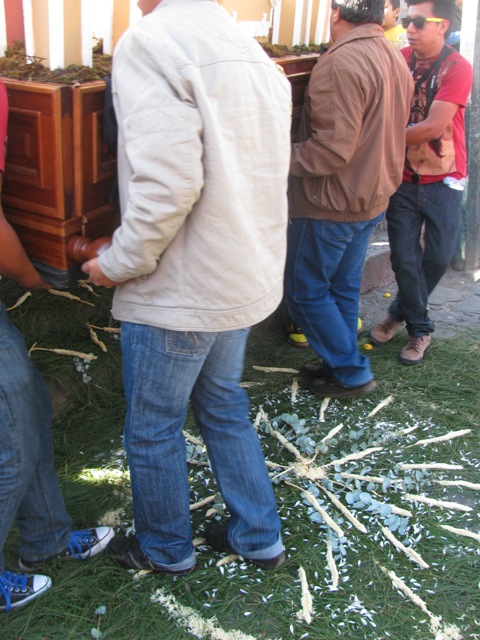
they work all night - this is dyed sawdust
the acolytes and first steps onto the first alfombra
here comes the procession
ahead of the procession
orange halves make flowers
the little boys follow the procession and slip under the anda to help carry
the men help the woman to carry the first anda
Not an easy job - a "sacrifice" for their faith
you see the dyed sawdust carpets more in other pueblos - they use purchased or home-made templates
oranges!
carrots, oranges, and skillfully folded leaves
the front of the procession - the woman, and the men carrying paintings
the different mens and womens groups linethe streets on each side of the alfombras
after the mens and womens groups, the acolytes and then the andas
the second anda, with the Christ figure
a solemn occasion
any beautiful thing
People work all night only to have the carpet destroyed when the andas pass - "that's the sacrifice"
a little tired
filling the template
women carrying the first anda across the first alfombra

Wednesday, January 30, 2013

Somehow the fotos I wanted from the last post didn't attach themselves. I will try again. The first is the entrance to my house-to-be, the second our student Maria (16), painting. The third is the head teacher of our project, Chepe or Jose Mendez, teaching a class in drawing. To see the Ayudame website, please go to www.paintmyfuture.info
It has been way too long since I have posted here. It is now January of 2013 and I have been living in Guatemala for 6 years and 4 months, in San Pedro la Laguna for nearly five years. And I have finally bit the bullet - buying a piece of property and subsequently starting a house. I asked myself sometime last year (since I'm now 77 years old) What do I want to do with the rest of my life?? Since I've been a gardener, homesteader or farmer since 1966 (part of the Back to the Land movement at that time)the answer came pretty quickly: I want to build something, I want to create in and with the earth. So with some sadness and trepidation I took the money that was intended for my old age and then my children's inheritance, and plunked it down - probably paying too much for 1/4 Acre (nearly $22,000) but hopefully my house - which is colonial style and should be beautiful when finished - will come in about the same. NOT bad, all told. But money isn't the point: the point is to live in a place I love for my coming years, and slowly (maybe really slowly) landscape it into a place of function and beauty. My concept is Edible Landscaping. I want most of the garden to be terraces (since it's on a slope) of fruits, veggies and herbs. This will be easier because you can garden year-round. There should be few dry or dead spots at any time of year, but of course the challenge will be making all of it look and smell wonderful. Following my friend Huck Rorick's example, I want the path to the house lined with herbs....lavendar, rosemary, mint, etc. All plants that smell good. That smell of life and the earth. There will be a lot of sun in front of the house and a lot in one part of the upper garden...so those will be planted with the sun and warmth-lovers...strawberries along the edge of the patio, (the someday-stone-patio) zucchini and tomatoes up in the sunniest spot (they are prone to mildew in the humidity of this lake area.) That's the dream. I go up to the property from the place I'm staying til it's done and just sit or stand around. I just like being there. Meanwhile the project Ayudame a Pintar Mi Futuro continues to grow. We've been working on our communal garden, thanks to money from the Marigold Ideas for Good foundation; we are thus employing some of our day-worker fathers and their older sons to do the heavy rock-moving, stump-removing, fence-building hard work of terracing and putting in a fence and water system. Then the families who are truly interested will divide up the plots and use our provided seed to start their gardens. After this, their work will be done voluntarily and the group will decide how to divide and perhaps market the proceeds. I am interested in better nutrition for the families, and insistent about doing this organically, but the parents (after a visit to the local permaculture farm with my friend Lynn Renn from Sebastopol) are getting on board with that. They are definitely excited to have plots of their own. Our Saturday classes continue, now with some 32 kids in attendance each week, and the moms will get a basket of food again this month. Thanks to donations via indiegogo.com, we were able to pay for the school expenses of our five older kids who take private classes beyond the Saturday group class. We helped with this, this year, because we recognized how hard it is for poor kids to afford the fees in the equivalent, here, of junior high and high school. We lost one good painter to the lure of work for cash, instead of school, and became aware of the danger. our

Friday, December 31, 2010

Shamanes and curanderos

I apparently haven't written about the use of shamen and healers in San Pedro la Laguna, Guatemala, which is a tradition very much alive and well even tho Evangelicism has a such a strong hold (Catholicism has embraced Mayan traditional activities much more than the Evangelical churches, who even generally supported the army in their war against the indigenous in the 80s.)

My friend Jose's wife Micaela broke her ankle the day before Christmas. The family immediately called a woman curandera, a bone-healer. You can read about them on the ArteMaya.com website, but usually they are known to be healers from birth but don't start working as a healer until they find their curing bone, which calls or reveals itself to them in one way or another at some point in their 20s or 30s.

So this woman rubs the bone on the affected area (which can be very painful) until the broken bones are aligned, rubs the area with a pomade (don't know what's in it) and wraps it. There is no burning of candles or incense during this treatment, which is not regarded as a ceremony in that sense.

In the case of an accident like this, or when their little niece fell in the street and couldn't sleep the next night, or when Jose's son Lucas hurt himself badly falling from a flag pole, a shaman will also be called for the Traida de la Alma ceremony (depicted in one of Jose's paintings....see www.paintmyfuture.org)
This person lights candles and incense, prays, and then taking his small whip, goes to the site of the accident, usually with one family member, in the middle of the night as the soul is thought to be sensitive and easily-distracted or disturbed by street traffic or passersby, and they want it to make its way back to the injured person. At the site of the accidnet the shaman will pray and talk to the soul, reminding it of all the things it misses in the life of the person, and encouraging it to return. The whip is then used to beat the path behind the soul as it returns to the person's home, where the injured person waits, often asleep. When they wake they are predictably thirsty, as the soul hasn't drunk water in a long time.

With that piece of the soul returned to the body, the person usually sleeps well, becomes less anxious, and the body recuperates more quickly.

On this occasion, a woman shaman did the ceremony in the house (I heard of this in the case of the litle girl who fell, as well) and she simply symbolized the route from the place where Micaela fell with a line of candles, and did the same action along the line of candles, bringing the soul home.

In this case, neither of these - treatment or ceremony - seemed to work....Micaela was still in a lot of pain, and couldn't sleep or tend her home (which was lucky for me because I got to become part of the family for a few days, preparing food, cooking, and cleaning,)

So yesterday a different bone healer was called, and when the medical doctor (family friend) came to visit in the evening he prounced the bone in place and beginning to heal. The family also had a male shaman come and he did the whole ceremony from the point of fall. Today she is remarkably better.

It was interesting to me to watch Jose take over many of her tasks --cooking, sweeping the floor, cleaning the bathroom and so on, even buying stuff in the mercado in the mornings with all the women lined up to select and bargain, When she's able I've rarely seen him do any of these things. However her mother and two sisters who live next door on either side also help. Wonderful for me to see the family cooperation and fun.

Unfortunately no fotos to add to this story.

Saturday, September 18, 2010

Guate funeral


Seven children; 69 grand and great-grand children. Died in his home in the midst of his family at the age of 95. Carried to the church for the last time in the hands of his son and grandsons, and then to the cemetary.

There were a lot of Tz'utujil words about his life, (this grandfather of my friend Jose) but I only got that he was a farmer and businessman - he and his brothers had the first buses on the new highway from San Pedro la Laguna to Guatemala City in 1957.

The sign carried by the children in the front of the procession from the church to the cemetary, said: "Little Grandfather (Abuelito) your grandchildren and greatgrandchildren love you, we will remember you forever. and your example will serve us well.. May God hold you in his Glory."

Evidently the grandfather was an important figure in the community, and thus the 200 or so people in his funeral procession. He was originally a trader in produce, his own and others, I presume - walking from San Pedro to the coast to sell, in 1935. He had the very first "molino" or corn grinder in the pueblo (thus reducing the amount of work each woman had to do to make tortillas.) The family still has this grinder. As I said above, he was one of the brothers who began the Mendez transportation business (a lot of old US school buses, now called "chicken-buses" by the foreigners, but which provided connection between the pueblos and to the Capital.) He was also a "pillar" of his church.

Taa' Menchu - Taa' means "elder" and Menchu indicates that his family first came to San Pedro from Totonicapan.

The family then observed the traditional (in this area) novenario, 9 days of mourning, serving some 200 people a day with a meal, and on the 9th day 1000 people.
Jose had to go pick up 300 live chickens to take to the 35 women of the family whom together will produce this meal.
Then the family continues for the next 40 days to spend a lot of meals with the bereaved grandmother.
I am impressed. SO much work and money spent, so much time together to help this close family through the transition.

Saturday, August 21, 2010

Children of Guatemala


THE CHILDREN OF GUATEMALA
As I sat in the park in Antigua Guatemala, my first week as a Spanish student there, a boy of perhaps six came up to me with a shy expression and a wooden box to put my shoe on so he could shine it. He said something I didn’t understand and gestured at my shoes…I shook my head and indicated that they weren’t made to be shined. He looked at them dubiously for a moment and then wandered away, eyeing the shoes of each person sitting on the stone benches (old men, family groups, couples, and the occasional single person like me) as he passed.
A young boy about his age caught his eye. This boy was dressed in suit-pants and a white buttoned shirt; his hair combed back. He was with his family, and his father was blowing bubbles for him from a small bottle in his hand. The boy was shouting with delight and rushing back and forth to chase each new bubble. The shoe-shine boy paused for 4-5 minutes--watching the boy’s pleasure, perhaps; noting the interaction between father and child. Then he hitched the strap of his box up higher on his shoulder, as if suddenly remembering his responsibilities, and moved on down the path.
This was one of the first things that struck me about Guatemala: the old people working—firewood or bags of rocks strapped to their backs; pushing huge vending carts up the cobblestone streets, and children working--selling newspapers, fountain pens with your name on them, and picture cards, or shining shoes. Some of these children are working with or for their mothers, vending textiles, or begging with a bowl on one side of the street while mom sits on the other. But many are by themselves at 5, 6, 7 years old in a reasonably big city.
Children working became even more evident when I moved to a rural pueblo at the side of Lake Atitlan. But here it was more often with the family and not necessarily for money (though at the dock in Santiago you will be set upon by dozens of children vending bracelets, key rings, and other crafts items...and occasionally begging.) In both San Pedro, where I’ve lived for three years, and San Pablo, where I volunteer in the school, the children work for family – carrying corn to be ground, food purchases from the store, holding balls of yarn while mama winds them, or holding the homemade tool which twists the maguey twine made in San Pablo while mom plaits the plant fibre into the rope from her position five yards up the street. In San Pablo I saw two boys, perhaps 8 and 10, pulling a huge bull on a rope to tether him in another grassy spot. In slightly more sophisticated San Pedro, I often see a 13 year old carrying a man-size bundle of firewood strapped to his back via the mecapal across his forehead, and know well a 14 year old who helps his father get a pig on a table to slit its throat. The families I know think nothing of asking their children of all ages to drop what they’re doing and run to the store for them, and I never hear a “thank you” for their efforts. It is simply accepted that children help their parents as part of being in a family…just as their parents once did.
Another immediately-notable thing about Guatemalan children is the respect and affection they evidence for their parents and their elders in general. Fifteen-year-old young men walk with their arms around the shoulders of their much smaller mothers. And when I first arrived in San Pedro, I noticed a line of 3-4 adolescent boys lined up to kiss the hand of an old man, an elder, sitting on the side of the street. There is also enormous familial affection, evidenced everywhere: young brothers and sisters walk holding hands; a teen-age boy cares for his much younger brother, holding him on his shoulders, or by the hand. All of this is almost too common to mention, but not so common in the U.S. Perhaps this caring is part of the net that makes working with family not only tolerable but enjoyable.
Guatemalan children, especially the poor ones I know, share a bed with brothers and sisters and sometimes parents. Hand-me-downs from older sibs is the norm. Few have toys, certainly not more than one or two, and these are also shared. If you give a poor child some food, they will invariably tuck a part of it in some crevice in their clothing for their brother or sister.

In most other respects, of course, they are like children everywhere: curious, inventive, full of energy, fun, and teasing.
I asked a young man of 20--who told me he worked side-by-side with his father in the fields, hoeing corn and whatever else needed doing, from the time he was six or so—how that felt. Was it like drudgery? Did he resent it? Was it in any way fun? (showing my bias by my questions, of course.) He said no, he never resented it; he was proud to work beside his dad. “And there were no diversions or distractions in those days (a mere 14 years ago or less),” he said. “No TV, no video games. We were happy to have something to do and proud to help. It’s a little different, now.”
In this slightly more modern town, affected by much tourism over the past 30 years, things are changing…for children, perhaps more quickly than for anyone else. Plastic toys have arrived in cheap droves….sold in the flung-up booths along the street during the week of Feria. They break quickly, so the cry goes out for more. Many children have at least rudimentary TV channels available in their homes or that of a friend; Hannah Montana items (a lunchbox, backpack, or actual toy!) suggest that you are “in the know,” one of the chosen ones (we can all remember this from our own childhoods.) Envy thrives. Some young girls are now wearing sports clothing, instead of the traditional wrapped skirt, belt and woven blouse.
These are not bad things in themselves, but as young people begin to want things from the wider world (in particular the U.S.) more than they want what their parents have to teach them, as cellphones and IPODs and gameboys become the desirable items and their grandparents know nothing about them, a measure of respect is lost. The sculpted hair of the boys and makeup the young girls want separate them even more from their befuddled grandparents…still immersed in centuries of tradition…and a generation gap ensues. And of course for those families who can afford to send their children to university in the Capital, the children grow away from home. I think that the family net is strong enough here to hold again the stretching of the bonds; I hope that’s true…and that the children of this generation gain more than they lose from all these changes.

Miranda Pope works with preschool children in San Pablo in her project (www.letsbeready.org) and with 5 to 13-year-old children of single mothers in her project in San Pedro la Laguna (www.paintmyfuture.org.)

Friday, August 20, 2010

Culture conscious

Yesterday a local friend told me that they were having his baby's baptism at 9 at the church, and at 10 I was invited for almuerzo at their house. So there I was at 9 at the church, long skirt and traditional-fabric shirt on, only to find that mass was currently in session, so I stood at the back of the church with the group of jovenes in their creatively-spiked hair. All the usual standing and sitting and kneeling, tho not as much of the usual call-and-response recitations I like so much, but a marimba band and some mediocre singing. At 9:50 I gave up thinking that they were going to do the baptism at this short time before the almuerzo, so I walked thru the windy dirt and stone alleys to his house....or his parents' house. (He - at age 27 - still lives at home with mom and dad, his wife and two children, and his two adult sisters.)
So I entered the house via their molina on the street...direct entry into a dark gloomy room with a big machine for grinding corn which makes a huge racket--belts slapping, generator roaring. Then walked thru a flimsy curtain into a back passageway which opens to the left into a roofless courtyard (with a view of the top of Volcan San Pedro, which I wish I had a better view of!) Then across the roofed side of the courtyard into the kitchen....a nearly-empty room with pans hanging on the walls, a big armoire at the end full of pots and pans, a simple table on the left, and a huge flat-topped wood-fired stove on the right with the big chimney going up thru a hole in the roof. On the stove were two HUGE pots, one full of cabbage. So first I helped chop some cabbage, which they mix with a little hierba buena/mint and a little limon and eat fresh. Then my friend's older brother came in from somewhere and we talked about how his work at the bar was last night - and then I sat and watched his mother chopping the heck out of a pile of chickens, on a lower cement table attached to the stove. At some point I asked the brother if he grew up in this house and he said they'd lived there since he was 11....(so 22 years, but he moved out at 20)...before that they all lived with his grandparents up near El Centro. So he grew up with this constant racket from the molino! No wonder he does so well as a DJ (with the noise of the loudspeakers.)
Then a bustle, the whispers that the parents and baby were coming from the church, where they had had the baptism AFTER mass, of course, and a big woman came in carrying the baby and man came with her (the padrinos) and then Arecely and Henry (who took off his outer shirt and showed me he was wearing my birthday present Virgin Mary tshirt underneath,) and they all hustled into the main room. They asked if I'd like to sit with them but I chose to sit outside with the rest of the family since I knew the talk inside would be relatively serious and all in Tz'utujil. So I took the baby out of the fancy padded stroller she was in and held and rocked her for awhile and the family borrowed my camera and took some fotos, and then she was asleep so I was served first, a little ceremoniously as guest: the usual, rice with bits of carrots and red peppers, chicken, cabbage, and the broth it was all cooked in (very sabroso) on the side.
While waiting I had spent time watching the molino being worked by the younger sister while the older (who will soon be married) washed everything in sight in the hall and courtyard including taking a bucket of water and throwing it into the bathroom - off the courtyard - and then mopping everything down with a towel/broom (so that's why bathrooms here are always soppng wet.) And the molino sister showed me how to make a tortilla from the wet masa, and I watched two or three women come in with their cooked corn with a little "cal" added (white calcium powder?) and grind it into a mush, scoop it together into their bucket and walk home with it in the small plastic bucket on their heads.
So that's all there was to it, except for listening to a long oration by the padrino in Tzu on how the child should be raised, and then they got ready to leave but I insisted on taking photos of the mother/father/madrina/padrino and baby together, and then just the padrinos with the baby (I don't know what protocol is, but I figured....) Evidentally they are in charge of the child's spiritual life, but it didn't sound like it was too huge an actual responsibility. It seemed very important that he was a man who hadn't drunk in many years.

So that was that cultural event, but on the way home I caught the sub-director of the school next to an extranjera friend's house who also owns a restarurant/lavandaria/bakery and listened for a rapt hour to her stories of all her students are doing about recycling, and producing products from recycled matierals, learning about marketing, advertising, etc. in the process....but mainly coming up with their own great ideas. So I was stoked about that and walked home all happy.

Thursday, July 01, 2010

Ooopss.....it's down time.


The families left homeless by the mudslide are safely ensconced in a place that will work for now, and I've spent the money donated by friends in getting them shoes, some clothing, some work tools, and so on. We've had our every-six-weeks giveaway for the 15 mothers in our project, so I have no more work to do for that. And Feria has set in to San Pedro la Laguna all week and, I hear, next week. Therefore all my local friends are involved in things that have nothing to do with me (processions, for one)and I am feeling....a little at loose ends. My two closest gringa friends are out-of-country, I've already visited the two couples I know..... So this is one of the places you come to when you live in a country that is not your real home.

When I first got to know some of the local people I was very excited to think we could create good friendships across cultural and linguistic barriers. That feeling lasted for probably 9 months or so until we ran into some of those cultural things that separated us - language, for one. We speak spanish together, and have great conversations on sometimes deep personal topics. But when they are all together, and especially when they party together - like during Navidad and Feria - they speak Tz'utujil. So I am just left out, or they have to exert extra effort to translate for me. Both happen, but neither are completely comfortable; I notice I am not invited as often. And when there are local activities, like the traditional dancing, or a procession from the church - well I can watch, but I am not part of what is going on, and my very watching sets me apart. Reality sets in...on both sides, I suspect.

My dishes and my wash are done; I've swept the floor. So now I can read, I can write to friends at home (although the longer I live here the less energetic that becomes,) or I can blog - as I'm doing. I can meditate - and on a grey day like this one has become (after a week of heavy rain) that would feel good.
And I can practice living in the present moment even when the present moment is quiet and a little empty. Good practice.

And I can upload an image from last week's procession in San Juan la Laguna - the pueblo to the west. Which I did attend, with local friends.

Sunday, June 13, 2010

Paint My Future/ Ayudame a Pintar Mi Futuro


This is a photo of our project group in November 2009. We have added 4 more families since then. Our website www.paintmyfuture.org.

Wednesday, June 02, 2010

Lost but still not forgotten

Today I met with another family who lost home and livelihood in this landslide. Flora has four children and is pregnant; husband Fredy makes a living crafting necklaces for the tourists. Fortunately he had his materials and tools in a backpack with him in town when the deluge came, but Flora and the children escaped with nothing. So i went through my accumulation of cortes (fabric that forms a skirt) and we cut some up to fit the older girls, a big one for mom. Then for $15 or so I managed to get underwear, a big plastic bucket for doing wash, shampoo, 4 towels, and the painters I work with donated food. And yes...crayons and a coloring book for the kids.

And I have a list of 8 other families who have lost everything. So we will meet with them, one by one, to confirm immediate needs. The biggest need, of course, is a place to live, but I will have to trust to others for that one. I want to give them a change of clothing, a way to bathe and wash clothes, and hope.

Tuesday, June 01, 2010

Disaster

We are in the aftermath of a disaster, here in San Pablo. A landslide coursed down the side ofthe volcano through an area several hundred feet wide, taking with it about 15 homes. 150 families have been homeless for 5 days, because their houses are completely gone - with all their belongings and in many instances their livelihoods - or because it's still dangerous to return, or their house is still standing but full of mud; and of course the road is blocked.
All of this within a 1/2 mile of my house. The destruction is awesome...in the traditional way of using that word.
Today I met with a couple of mothers who are staying in the makeshift homeless shelters in a church and at the Muni center. Two of them had only the clothes they escaped in. I'm trying to understand the needs, and also the best avenue to get any donation to the people in greatest need. They say donated items are going to friends of the people in charge of the city; that rarely does anything reach its intended recipient. Because there are perhaps only 15 families left with nothing, I think a personal approach may be possible. Meet with them, ask what they need for now, and get it for them. The need for a new house and land is of course out of my reach; but someone I trust is in charge of restoration efforts here and is collecting money from local people. So if I can deal with now; they can deal with later. And I'll help how I can.
So for today it was underwear.
Tomorrow towels and shampoo.
And I think coloring books and crayons are in order as well.

Wednesday, May 19, 2010

So excited!

My trip to California last month was very successful, in terms of selling most of the lovely products of Guatemala artisans which I carried there (after a fun but frenzied few weeks of buying them)in order to benefit my two projects, and for seeing my wonderful friends and family and even getting a little dancing in. I also made connection with a bilingual preschool and (again) with the high school spanish students. What a really great time!
I've been back a week, and two friends from Chico have contacted me to offer to help with the project here. So I am feeling very positive and hopeful about our future. One friend offered to "host" our project in their foundation, which already helps in Belize and Haiti. The other offered to head a "Friends Of" group for fundraising. So maybe Jose (the 33 y.o. painter who heads the project) and I will get more help in providing our (now) 15 single mothers with a food giveaway every six weeks, and the kids with the saturday classes in drawing and painting. Their offer to help us fundraise makes me set my sights a little higher: maybe we could find madrinos/padrinos (sponsors) for all the kids, which would free me up to help the mothers with literacy issues (4 can't even sign their names,) and the children with the many emotional and learning problems that come from living in disrupted and impoverished families. Maybe we could even develop a small loan program to help with things like fixing the roof or the water system, or buying a sewing machine or other tool to earn a living.
Ultimately our goal is to become our own NGO and to upgrade the art gallery so that the works of the main painters and their young students can help the project be self-sustaining, as it was originally.

Saturday, April 03, 2010

Addendum to previous post.

I had difficult loading up enough photos to do honor to Semana Santa in San Pedro la Laguna, but if you'll go to my facebook page -- I think it's under Mira Talbott-Pope -- you'll find a photo album for Semana Santa 2010 that has 25 or so photos with descriptions that give some sense of the history and culture.
I love living in San Pedro. You get used to wherever you live, but when I think about this place, looking at it from the outside, it's so deep and rich. I feel blessed.

Thursday, April 01, 2010

SEMANA SANTA 2010-04-01


El dia de la procesión de los niños., today…dia del virgen. This procession through the alfrombras, or beautiful fruit-and-flower carpets, in the streets ¨to the cross¨ affected me more than recent others have, maybe because the procession of children in special dress or costume-- some of the boys carrying the andas of Christ; some of the girls carrying Mary-- stopped on a large straw mat at various corners of the main calles of San Pedro (where usually I go to the ATM machine, buy my cards for my celfone, or buy my fruit and vegetables.) There tables had been set up with candles, flowers, and incense, and several old ladies in traditional dress, under a huge double arch of fruits and vegetables.In each of these spots or “stations of the cross,” a different child read a passage from the bible describing this station (Christ fell here and a soldier helped him up, it was difficult here and a follower wiped his brow, etc.) and all the people recited the appropriate group response. Really beautiful to hear the solemn voices. And then the whole column proceeded slowly to the next station, the or carriers with a side-to-side swaying motion, and the old ladies in the rear singing out of books that looked as old as they did.The children were adorable, as always,but the thing that always gets me is Mary following her son to his cruxificion. It was after all, a true story, whatever Mel Gibson made of it. I could become a Catholic, for all the chanting and incense, and the personal story of Christ; I just happen to have bad feelings about the Catholic Church.Que lastima.